


High-income professionals face a frustrating reality. You work incredibly hard, earn substantial income, yet watch enormous portions disappear to taxes every year. Consider a surgeon earning $800,000 annually who could face a tax bill of $312,000 or more. The thought that often crosses their mind: “There has to be something we can do. I feel like I’m working for the IRS.”
The good news? There are advanced tax planning strategies for high-income earners that most professionals never hear about. While you can’t use the same write-offs as business owners, there are sophisticated strategies built into the tax code that high earners consistently overlook.
When you’re earning serious money, you need sophisticated strategies that match your income level, potentially saving $50,000 to $200,000+ annually through proper implementation. Here’s what separates successful high earners from those who just pay whatever the IRS demands: they understand that tax planning for high income earners requires a completely different playbook.
Let me show you the exact strategies that work for my highest-earning clients – from fundamental approaches every high earner should implement to advanced techniques that can transform your tax situation dramatically.

Strategy #1: Maximize Contributions To Retirement Accounts and HSAs
Your first defense against high taxes starts with maxing out every tax-advantaged account available to you. This isn’t just good advice – it’s essential for implementing effective high income earner tax strategies.
401(k) and 403(b) Maximization
For 2025, you can contribute up to $23,500 to your 401(k) or 403(b). If you’re over 50, add another $7,500 for a total of $31,000. Every dollar reduces your taxable income dollar-for-dollar.
Here’s the math that matters: if you’re in the 37% tax bracket and max out your contribution, you save $8,695 in federal taxes immediately. That’s not counting state tax savings.
But here’s where most people stop. Don’t.
Health Savings Accounts: The Triple Tax Advantage
HSAs offer the best tax deal in the entire tax code. For 2025, you can contribute $4,300 for individual coverage or $8,550 for family coverage. If you’re 55 or older, add another $1,000.
Why HSAs are so powerful:
- Tax deduction upfront: Contributions reduce your current taxable income
- Tax-free growth: All investment gains are tax-free
- Tax-free withdrawals: Money used for qualified medical expenses is never taxed
The strategy most high earners miss: you don’t have to use HSA money immediately. Pay medical expenses out of pocket, save your receipts, and let the HSA grow. You can reimburse yourself decades later with no time limit.
It’s like having a second IRA with better tax treatment.
SEP IRAs for Side Income
If you have any 1099 income from consulting, speaking, or side businesses, SEP IRAs let you contribute up to 25% of that income, up to $70,000 for 2025. This is pure gold for high earners with any self-employment income.
Strategy #2: Execute Strategic Roth Conversions
Roth conversions are where sophisticated tax planning really shines. These strategies help you build tax-free wealth while managing your current tax burden.
Backdoor Roth IRAs
High earners get shut out of regular Roth IRA contributions. If you earn over $165,000 ($246,000 married filing jointly), you can’t contribute directly to a Roth IRA. The backdoor Roth is your workaround.
Here’s how it works:
- Contribute $7,000 to a non-deductible traditional IRA
- Immediately convert it to a Roth IRA
- Pay taxes on any earnings (minimal if done quickly)
- Enjoy tax-free growth forever
One critical note: if you have other traditional IRAs with pre-tax money, this gets complicated due to the pro-rata rule. Consider rolling old IRAs into your current 401(k) first.
The Mega Backdoor Roth Strategy
This is where sophisticated planning really pays off. If your employer’s 401(k) plan allows after-tax contributions, you can contribute up to $70,000 total for 2025 (including employer match). Here’s the process:
- Max out regular 401(k): $23,500
- Make after-tax contributions: up to $70,000 total
- Immediately convert after-tax portion to Roth
- Build massive tax-free wealth
A tech executive could use this strategy to funnel an additional $46,500 into Roth accounts beyond their regular contributions. That money would grow tax-free for decades, creating substantial long-term wealth accumulation opportunities.
Strategic Timing for Maximum Impact
The timing of Roth conversions can make or break your strategy. Convert when:
- Your income is temporarily lower
- You’re between jobs or taking sabbaticals
- Market values are depressed
- You want to fill up lower tax brackets
Strategy #3: Cash Balance Pension Plans For Massive Tax Deductions
This is the type of strategy that could transform a high earner’s tax situation dramatically. Cash balance pension plans allow contributions that dwarf traditional retirement accounts.
Understanding Cash Balance Plan Limits
For 2025, cash balance plan contributions can reach as high as $341,000, compared to just $70,000 for 401(k) plans. The actual amount depends on your age, income, and years until retirement.
Here’s how contribution limits typically work by age:
- Age 40: $50,000-$80,000 annually
- Age 50: $100,000-$150,000 annually
- Age 60: $200,000-$341,000 annually
These aren’t fixed numbers. They’re calculated by actuaries based on what’s needed to fund your target retirement benefit (up to $3.5 million lifetime).
Why Cash Balance Plans Excel for High Earners
Cash balance plans work exceptionally well for:
- Professional practices (doctors, lawyers, consultants)
- Small business owners with high income
- Companies with few employees relative to owners
- Anyone seeking annual tax deductions over $55,000
The tax savings are immediate and substantial. A 55-year-old business owner contributing $180,000 to a cash balance plan saves $66,600 in federal taxes alone (37% bracket), plus state tax savings.
Comparing 401(k) vs. Cash Balance Plans
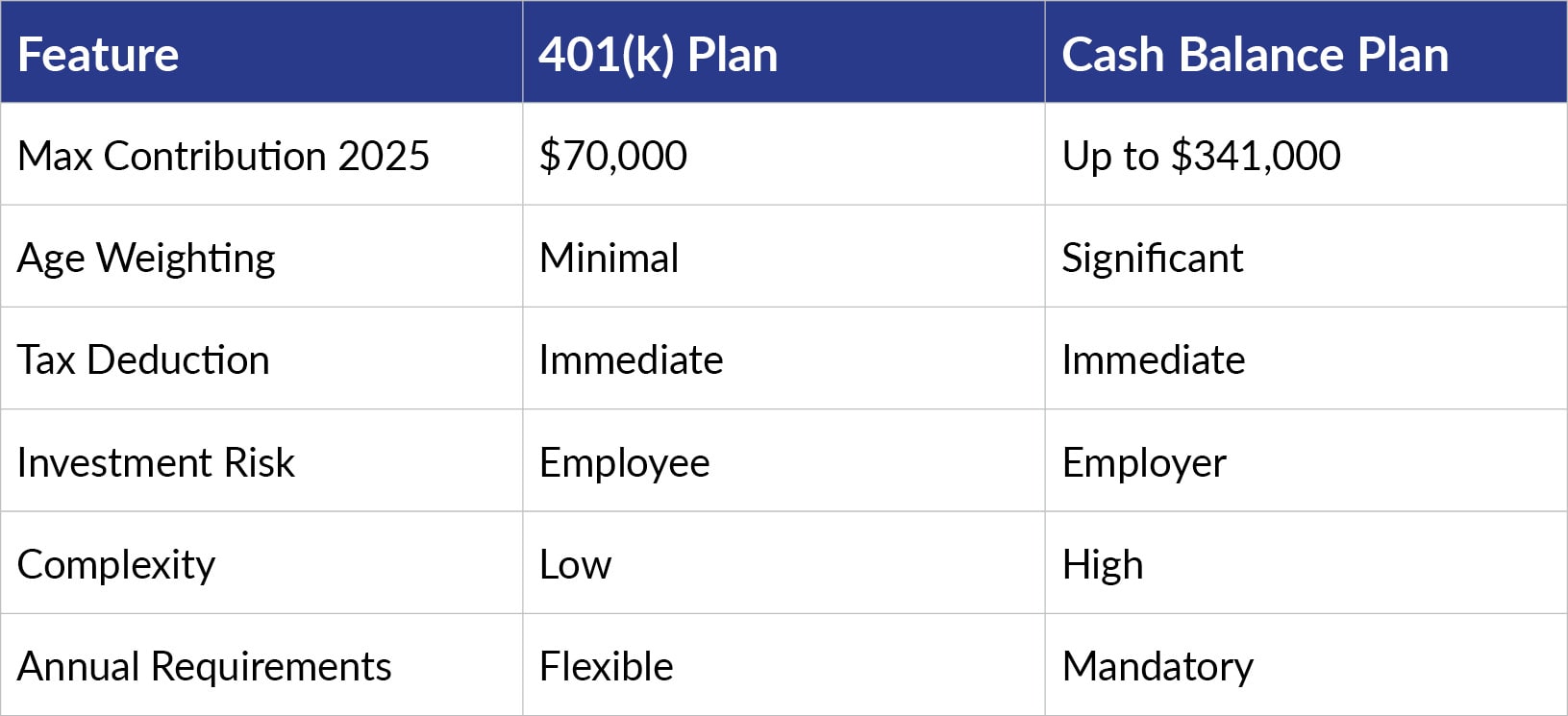
Implementation Requirements
Cash balance plans require:
- Consistent annual funding (not optional)
- Actuarial administration
- Coverage for eligible employees
- PBGC premiums
- Higher administrative costs
The benefits generally far outweigh the costs for high earners, but you need adequate cash flow to fund the plan consistently.
Strategy #4: Section 83(i) Equity Compensation Deferrals
For employees of private companies, Section 83(i) offers a unique opportunity to defer taxes on equity compensation for up to five years.
How Section 83(i) Works
Section 83(i) allows qualified employees to defer federal income tax on stock options or RSUs from private companies. The deferral period ends on the earliest of:
- When the stock becomes transferable (including to the employer)
- When you become an “excluded employee” (CEO, CFO, 1% owner, etc.)
- When company stock becomes publicly traded
- Five years after vesting
Eligibility Requirements
Company Requirements:
- Must be a private corporation (not publicly traded)
- Must grant equity to at least 80% of US employees
- All grants must have “same rights and privileges”
Employee Requirements:
- Cannot be CEO, CFO, or their family members
- Cannot be a 1% owner (current or past 10 years)
- Cannot be one of the four highest-paid officers
Strategic Considerations and Pitfalls
Section 83(i) deferrals come with significant risks:
- Tax Risk: You pay taxes based on value at exercise/vesting, even if stock value declines during deferral period
- Withholding Requirements: Employer must withhold at maximum rate (37%) when deferral ends
- Liquidity Risk: You need cash to pay taxes when deferral period ends, but stock may still be illiquid
- Administrative Burden: Requires mandatory escrow arrangements and complex compliance
For most high earners, Section 83(i) works best when you expect to be in a lower tax bracket when the deferral period ends, or when you need to manage the timing of large equity events.
Strategy #5: Use Donor-Advised Funds And Charitable Trusts For Smart Giving
Charitable giving becomes much more tax-efficient when you’re a high earner, especially with current deduction limitations.
Donor-Advised Funds (DAFs)
DAFs let you bunch multiple years of charitable contributions into a single tax year. This strategy often pushes you over the standard deduction threshold, maximizing your tax benefit.
Here’s an example: Instead of donating $10,000 annually for five years, contribute $50,000 to a donor-advised fund in year one. You get the full deduction immediately and can recommend grants to charities over time.
This strategy is particularly powerful when:
- You have a high-income year (bonus, stock option exercise, etc.)
- You want to offset the tax impact of a large gain
- You’re already close to itemizing deductions
Charitable Remainder Trusts (CRTs)
For extremely high earners with significant appreciated assets, CRTs provide both tax benefits and income streams. You transfer appreciated assets to the trust, get an immediate tax deduction, avoid capital gains tax, and receive income for life.
CRTs work best when you have:
- Highly appreciated stock or real estate
- Income needs in retirement
- Charitable intentions
- Assets worth at least $1 million
The tax deduction alone can be 20-50% of the asset value, depending on the trust terms and your age.
Qualified Charitable Distributions
If you’re over 70½ with traditional IRA funds, you can make qualified charitable distributions directly from your IRA to charity. This counts toward your required minimum distribution but doesn’t increase your taxable income, effectively making your charitable giving tax-free.
Strategy #6: Take Advantage Of Tax-Loss Harvesting
Tax-loss harvesting has become incredibly sophisticated thanks to automated platforms. This strategy involves selling investments at a loss to offset capital gains and reduce your tax bill.
How Modern Tax-Loss Harvesting Works
Robo-advisors like Betterment, Wealthfront, and Schwab Intelligent Portfolios now automate this process. Their algorithms continuously monitor your portfolio and harvest losses when opportunities arise.
Here’s what these platforms do automatically:
- Identify securities trading below their purchase price
- Sell losing positions to realize losses
- Immediately reinvest in similar (but not identical) securities
- Ensure compliance with wash-sale rules
- Optimize the timing for maximum tax benefit
The Numbers That Matter
Wealthfront estimates their clients have saved about $1 billion in taxes over the last decade through automated tax-loss harvesting. For nearly 96% of participating clients who have used the service for at least a year, the estimated tax benefit exceeds their advisory fees.
On average, clients’ tax benefit has been 7.6 times Wealthfront’s 0.25% annual advisory fee over the life of the account.
Platforms That Excel at Tax-Loss Harvesting
Wealthfront: Offers tax-loss harvesting on all taxable accounts with no minimum balance. Their system is considered among the most sophisticated.
Betterment: Provides “Tax Loss Harvesting+™” for all clients at no additional cost. No minimum balance required.
Schwab Intelligent Portfolios: Includes automatic tax-loss harvesting for accounts over $50,000. No management fee for basic service.
Vanguard Digital Advisor: Offers tax-loss harvesting as part of their comprehensive service for accounts over $100.
Maximizing Your Tax-Loss Harvesting Strategy
To get the most benefit:
- Use tax-loss harvesting in taxable accounts only (not retirement accounts)
- Coordinate with your overall tax strategy
- Consider the impact on your asset allocation
- Don’t let the tax tail wag the investment dog. Maintain your long-term strategy
You can use harvested losses to offset capital gains first, then up to $3,000 of ordinary income annually. Any excess losses carry forward indefinitely.
Strategy #7: SALT Optimization Under OBBBA Changes
The One Big Beautiful Bill Act (OBBBA) dramatically changed SALT deduction planning for high earners through 2029.
The New SALT Rules
For 2025-2029, the SALT deduction cap increases to $40,000 (from $10,000), but with important limitations:
- Full $40,000 deduction for modified AGI up to $500,000
- Phases out by 30% of income over $500,000
- Cannot be reduced below $10,000
- Cap increases 1% annually through 2029
- Returns to $10,000 permanently in 2030
Strategic SALT Planning
- Timing Property Tax Payments: Accelerate or defer property tax payments to maximize the benefit in years when you can fully utilize the deduction.
- State Tax Payment Timing: Consider making estimated state tax payments in December to bunch deductions into optimal years.
- Income Management: For taxpayers near the $500,000 threshold, timing income recognition can preserve the full SALT benefit.
State-by-State Implications
The SALT changes provide the biggest benefits for high earners in:
- California
- New York
- New Jersey
- Connecticut
- Massachusetts
For example, a New York resident earning $450,000 annually with $35,000 in state and local taxes saves $9,250 in federal taxes (vs. the old $10,000 cap).
The 2030 Cliff Planning
Start planning now for the SALT cap returning to $10,000 in 2030:
- Consider accelerating major property tax payments into 2029
- Evaluate timing of home sales and purchases
- Plan for higher federal tax bills starting in 2030
Strategy #8: Advanced Asset Location And Tax-Loss Harvesting
Sophisticated high income tax strategies require coordinating your investment approach with your tax planning.
Asset Location Optimization
Asset location (where you hold different types of investments) can save high earners thousands annually:
Tax-Deferred Accounts (401k, IRA):
- High-yield bonds
- REITs
- Actively managed funds with high turnover
Taxable Accounts:
- Tax-efficient index funds
- Individual stocks (for tax-loss harvesting)
- Municipal bonds (for current income needs)
Roth Accounts:
- Highest growth potential investments
- International stocks
- Small-cap growth funds
Advanced Tax-Loss Harvesting Strategies
- Direct Indexing: Own individual stocks instead of funds to maximize harvesting opportunities
- Tax-Aware Rebalancing: Rebalance using new contributions and tax-loss harvesting instead of selling appreciated assets
- Factor Tilting: Use harvested losses to implement factor tilts (value, momentum, quality) while maintaining market exposure
Strategy #9: Residency Planning For Remote High Earners
The shift to remote work has created unprecedented opportunities for tax planning for high income earners through strategic residency changes.
High-Impact State Tax Planning
Moving from high-tax to no-tax states can save massive amounts:
From California (13.3% top rate) to Texas (0%):
- $500,000 income saves $66,500 annually
- $1,000,000 income saves $133,000 annually
From New York (10.9% top rate) to Florida (0%):
- $500,000 income saves $54,500 annually
- $1,000,000 income saves $109,000 annually
Legal Requirements for Residency Changes
State tax authorities aggressively audit high earners claiming residency changes. You must establish clear domicile in your new state:
- Physical Presence: Spend more than 183 days in the new state
- Economic Ties: Move primary bank accounts, investment accounts, business activities
- Personal Ties: Register to vote, get driver’s license, register vehicles
- Property Ownership: Establish primary residence in new state
Common Residency Planning Mistakes
- Mistake #1: Not maintaining detailed records of time spent in each state
- Mistake #2: Keeping too many ties to the old state
- Mistake #3: Not understanding source income rules
- Mistake #4: Filing incorrect tax returns during transition year
Professional athletes, remote executives, and business owners have successfully used residency planning, but it requires meticulous documentation and planning.

Combining Strategies For Maximum Impact
The real power comes from combining multiple strategies. Let me show you how these strategies could work together. Consider a 52-year-old business owner earning $750,000 annually:
Strategy Combination Implementation
Cash Balance Pension Plan: $200,000 contribution
- Federal tax savings: $74,000 (37% bracket)
- State tax savings: $15,000 (California)
Mega Backdoor Roth: $46,500 after-tax contribution
- No immediate tax benefit
- Significant long-term tax-free growth
SALT Optimization: $40,000 deduction (vs. old $10,000 cap)
- Additional federal tax savings: $11,100
Tax-Loss Harvesting: $25,000 in harvested losses
- Federal tax savings: $9,250
- State tax savings: $1,875
Total First-Year Tax Savings: $111,225
But the benefits compound over time. The cash balance plan contributions continue annually. The Roth money grows tax-free. The tax-loss harvesting continues indefinitely.
Over 10 years, this strategy combination could save over $1.5 million in taxes while building substantially more retirement wealth.
Implementation Timeline
Tax planning isn’t a December activity. Here’s when to implement each strategy:
Q1 (January-March)
- Set up cash balance pension plan
- Complete backdoor Roth conversions
- Review asset location strategy
Q2 (April-June)
- Implement automated tax-loss harvesting
- Make mega backdoor Roth contributions
- Assess SALT optimization opportunities
Q3 (July-September)
- Mid-year tax projections
- Adjust strategies based on income changes
- Plan year-end moves
Q4 (October-December)
- Final tax-loss harvesting
- Cash balance plan funding
- SALT payment timing
Common Implementation Mistakes That Cost Big
After implementing these strategies for hundreds of high earners, I see the same costly mistakes repeatedly:
Mistake #1: Trying to Do It Yourself
These strategies require precise coordination and expert implementation. A single error in cash balance plan design or Section 83(i) compliance can cost tens of thousands.
Mistake #2: Not Maintaining Adequate Cash Flow
Cash balance plans require mandatory annual funding. Don’t commit to a plan you can’t fund consistently, especially during economic downturns.
Mistake #3: Ignoring Employee Coverage Requirements
Both cash balance plans and Section 83(i) have strict employee coverage rules. Failing to cover required employees can disqualify the entire strategy.
Mistake #4: Poor Timing Coordination
These strategies work best when coordinated. For example, don’t do large Roth conversions in the same year you have massive cash balance plan deductions.
Mistake #5: Inadequate Record Keeping
Sophisticated strategies require detailed documentation for IRS compliance and audit defense. Use professional-grade systems for business expense tracking.
Working With Advanced Tax Planning Experts
Implementing these tax planning strategies for high-income earners requires expertise that goes far beyond typical tax preparation.
What to Look for in a Tax Professional
Essential Qualifications:
- CPA with high-income specialization
- Experience with cash balance plans and defined benefit administration
- Knowledge of equity compensation planning
- Proactive planning approach (not just return preparation)
- Technology-forward practice management
Advanced Capabilities:
- Multi-year tax modeling and projections
- Coordination with investment management
- Estate planning integration
- Business structure optimization
The Interactive Accountants Advantage
At Interactive Accountants, we specialize in implementing sophisticated high income tax strategies for professionals earning $500,000 and above. Our comprehensive approach includes:
- Advanced cash balance plan design and administration
- Equity compensation optimization strategies
- Multi-state tax planning for remote executives
- Year-round proactive tax planning
We also provide complete business tax services for clients with business interests, along with Cloud Bookkeeping Services: Secure, Scalable, And Smart solutions that integrate seamlessly with advanced tax planning.
Tax Planning In An Evolving Environment
Tax planning for high income earners continues evolving with changing laws and economic conditions.
Key Planning Considerations for 2025-2030
- SALT Cap Expiration: The return to $10,000 SALT cap in 2030 will significantly impact high earners in high-tax states.
- TCJA Provisions: Many favorable provisions are permanent under OBBBA, providing planning certainty.
- State Tax Competition: More states are eliminating income taxes to attract high earners, creating new planning opportunities.
- Technology Evolution: Continued advances in automated investment management and tax optimization.
Staying Ahead of Changes
Successful tax planning requires ongoing monitoring and adjustment as laws change and your financial situation evolves. The strategies that work best today may need modification as circumstances change.
Take Action On Advanced Tax Planning
The most important step is starting with a comprehensive analysis of your current situation and identifying which strategies offer the biggest impact for your specific circumstances.
Ready to implement advanced tax planning strategies? Contact us for a comprehensive tax planning consultation. We’ll analyze your situation and create a customized plan designed to minimize your tax burden while building long-term wealth.
For immediate help, download our Ultimate Tax Deduction List to identify additional opportunities you may be missing.
For official guidance on these advanced strategies, reference the IRS publications on retirement plans, equity compensation, and business taxation.
FAQs
What are tax planning strategies for high-income earners in 2025?
The most effective strategies include cash balance pension plans (contributions up to $341,000), Section 83(i) equity compensation deferrals, strategic Roth conversions, SALT optimization under OBBBA changes, automated tax-loss harvesting, and residency planning. These strategies can save high earners $50,000-$200,000+ annually when properly implemented.
How can a cash balance pension plan reduce my taxes?
Cash balance plans allow much higher contribution limits than traditional retirement plans—up to $341,000 for 2025 vs. $70,000 for 401(k) plans. These contributions are fully tax-deductible, providing immediate tax savings. A $200,000 contribution saves $74,000 in federal taxes alone for someone in the 37% bracket.
What is Section 83(i) and how do I benefit from it?
Section 83(i) allows employees of private companies to defer federal income tax on stock options or RSUs for up to five years. This helps manage the timing of large equity events and can defer taxes until you’re in a lower bracket or have liquidity to pay. However, it requires meeting strict eligibility requirements and involves significant risks.
Can high-income earners save tax through residency planning?
Yes, moving from high-tax states to no-tax states can save enormous amounts. Moving from California (13.3% top rate) to Texas (0%) saves $66,500 annually on $500,000 income. However, you must establish true domicile in the new state with proper documentation to avoid aggressive state audits.
Are robo tax-loss harvesting tools worth using?
Absolutely. Modern robo-advisors like Wealthfront and Betterment automate sophisticated tax-loss harvesting that can save high earners thousands annually. Wealthfront estimates their clients have saved over $1 billion in taxes. For high earners in the 37% bracket, every $1,000 in harvested losses saves $370+ in federal taxes alone.
How do I time SALT deductions under the OBBBA rules?
The $40,000 SALT cap (2025-2029) phases out above $500,000 income. Time property tax payments and estimated state taxes to maximize the deduction in years when you can fully utilize it. For those near the phase-out threshold, managing income timing can preserve the full benefit. Plan for the return to $10,000 cap in 2030.