


The moment I realized how much money high net worth families were leaving on the table changed everything for me. Take a family worth $15 million writing checks to various charities for years, getting standard tax deductions and feeling good about their giving. After establishing a private family foundation, their annual tax savings could jump from $50,000 to $180,000 while giving them permanent control over their philanthropic legacy.
That’s when it hit me: most wealthy families think charitable giving is just about writing checks and taking deductions. They’re missing the bigger picture entirely.
A private family foundation isn’t just about charity – it’s one of the most powerful wealth management tax strategies available to high net worth families, offering comprehensive private family foundation tax benefits that extend far beyond simple charitable deductions. Done right, it can slash your taxes, remove assets from your estate, and create a lasting legacy that spans generations. Done wrong, it becomes an expensive compliance nightmare that benefits no one.
Here’s what I’ve learned after helping dozens of families establish foundations: the families who succeed understand that foundations are sophisticated financial tools disguised as charitable vehicles. Today I’m going to show you exactly how they work and whether one makes sense for your situation.

What Is A Private Family Foundation?
A private family foundation is a tax-exempt organization established under IRS Section 501(c)(3) that’s controlled by a single family or small group of individuals. Think of it as your personal charitable corporation – you fund it, control it, and direct its giving for decades to come.
Legal Structure Basics: Unlike public charities that raise money from many donors, private foundations generally receive funding from one source: your family. You establish the foundation, transfer assets to it, and maintain control through board positions that can span multiple generations.
How Private Foundations Differ from Other Giving Vehicles
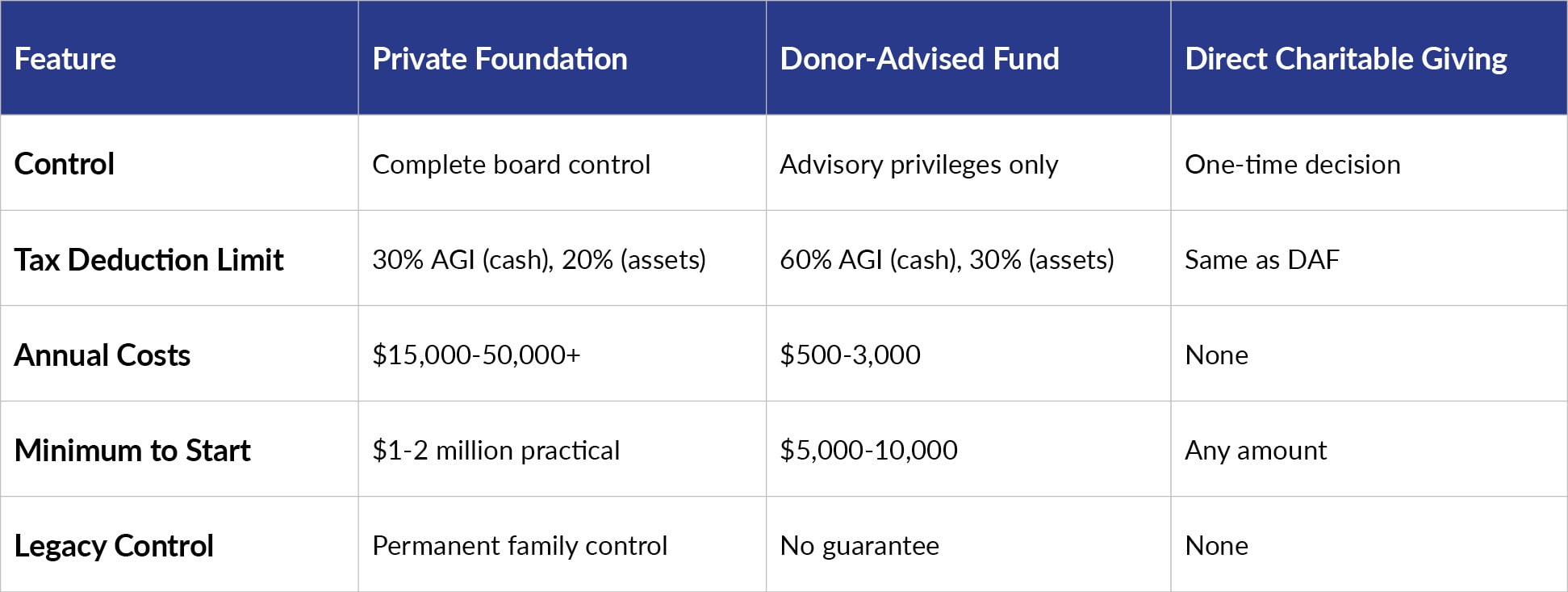
Who Typically Establishes Private Foundations
The families I work with usually have several motivations:
- Net worth exceeding $5 million with significant annual charitable giving
- Desire to involve children and grandchildren in philanthropy
- Need for permanent control over charitable distributions
- Complex assets (business interests, real estate, art) to donate
- Estate planning objectives beyond simple tax deductions
Here’s the key insight most people miss: foundations aren’t just about giving money away. They’re about maintaining control over significant assets while achieving multiple tax and estate planning objectives simultaneously.
Core Tax Benefits Of A Private Family Foundation
The private family foundation tax benefits go far beyond simple charitable deductions. When structured properly, tax benefits include reducing income taxes, eliminating capital gains, and removing assets from your taxable estate permanently.
Income Tax Deductions
Deduction Limits for Private Foundations:
- Cash contributions: up to 30% of Adjusted Gross Income (AGI)
- Appreciated securities: up to 20% of AGI
- 5-year carry-forward for unused deductions
Example: You have $2 million in AGI and establish a foundation with $500,000 in cash. You can deduct $600,000 (30% of AGI) this year and carry forward the remaining $100,000 for up to five additional years.
Strategic timing considerations: The 5-year carry-forward rule is powerful for families with variable income. You can make large contributions in low-income years and spread the deductions across higher-income years for maximum tax benefit.
Capital Gains Tax Avoidance
This is where foundations become incredibly powerful for wealthy families holding appreciated assets.
How it works: Instead of selling appreciated stock and paying capital gains taxes, you donate the stock directly to your foundation. The foundation can then sell the stock tax-free and use the full proceeds for charitable purposes.
Example scenario:
- You own $1 million in company stock with $200,000 basis
- Capital gains tax on sale: approximately $190,000 (23.8% including Medicare surtax)
- Donate stock to foundation: $0 capital gains tax
- Foundation sells stock tax-free: full $1 million available for charitable purposes
- Your tax deduction: $200,000 (20% of $1 million AGI)
Additional benefit: You remove the appreciated asset from your estate while maintaining family control over the charitable distribution of funds.
Estate Tax Reduction
Private family foundations provide permanent estate tax reduction because donated assets are removed from your taxable estate immediately while your family retains control through board positions.
Estate planning advantages:
- Assets transferred to foundation aren’t subject to 40% estate tax
- Board positions don’t create taxable interests for heirs
- Foundation assets grow tax-free outside your estate
- Multi-generational control preserves family values and priorities
Succession planning benefits: Children and grandchildren can serve on the foundation board, learning family values around money and philanthropy while gaining experience with fiduciary responsibility and governance.
Foundation vs. Donor-Advised Fund
Most families I meet have heard about donor-advised funds but don’t understand how they compare to private foundations. The choice between them often determines whether your charitable giving becomes a powerful wealth management tool or just basic tax planning.
Tax Deduction Comparison
Donor-Advised Funds offer higher deduction limits:
- Cash contributions: 60% of AGI
- Appreciated securities: 30% of AGI
Private Foundations have lower limits:
- Cash contributions: 30% of AGI
- Appreciated securities: 20% of AGI
For families making large charitable contributions, DAF limits can provide more immediate tax benefits, though private family foundation tax benefits offer superior long-term control and legacy planning advantages. However, the trade-off is permanent control.
Control and Decision-Making
Foundation Control: You establish a board (often family members) that makes all grant decisions. The foundation can exist indefinitely under family control, and you can change grant-making strategies as circumstances evolve.
DAF Limitations: The sponsoring organization (Fidelity, Schwab, community foundations) retains legal control over all grant recommendations. While they typically honor donor wishes, you have no legal guarantee.
Privacy Considerations:
- Private foundations must file annual Form 990-PF returns, which become public record
- DAFs provide more privacy since grant recommendations aren’t publicly disclosed
- Foundation board meetings and governance create additional public scrutiny
Cost and Compliance
Foundation Operating Costs:
- Annual compliance: $15,000-30,000
- Investment management: 0.5-1.5% of assets annually
- Administrative overhead: varies based on grant-making activity
- IRS excise tax: 1.39% on net investment income
DAF Costs:
- Administrative fees: 0.6-2% of assets annually
- Investment management: 0.05-0.75% annually
- No separate tax filings or compliance requirements
Break-even analysis: Private family foundation tax benefits generally make economic sense with assets exceeding $2-3 million, depending on your family’s situation and objectives.
Strategic Use Cases
Choose a Foundation when:
- Net worth exceeds $5 million with ongoing charitable intent
- Family governance and legacy planning are priorities
- You have complex assets to contribute (business interests, real estate)
- Multi-generational philanthropic education is important
Choose a DAF when:
- Charitable assets are under $2 million
- Simplicity and low costs are priorities
- You want higher deduction limits for immediate tax benefits
- Privacy is more important than permanent control
Hybrid approach: Many families use both vehicles strategically – DAFs for routine giving and foundations for legacy planning with significant assets.

Legacy, Governance & Next-Generation Involvement
The most successful private family foundations I’ve worked with understand that governance structure determines long-term success. It’s not enough to establish a foundation – you need to create systems that engage multiple generations and preserve family values.
Building Family Stewardship
Creating a Family Mission Statement: Before establishing your foundation, spend time as a family defining your philanthropic values and objectives. What causes matter most to you? How do you want to measure impact? What values do you want to pass to future generations?
Governance structure considerations:
- Board composition (family vs independent members)
- Term limits and rotation policies
- Decision-making processes (consensus vs majority vote)
- Next-generation preparation and education
Multi-generational engagement strategies:
- Junior board positions for younger family members
- Mentorship programs pairing seniors with rising generations
- Annual family retreats focused on foundation business
- Educational opportunities (site visits, impact measurement training)
Successful Family Foundation Example
Consider a typical multi-generational approach: A family establishes a $25 million foundation with the parents serving as initial board members. They structure governance to gradually include adult children and eventually grandchildren as voting members.
- Year 1-5: Parents control foundation, establish grant-making priorities
- Year 6-15: Adult children join board, learn governance and impact measurement
- Year 16+: Third generation begins participating, foundation evolves with family values
Key success factors:
- Clear succession planning from day one
- Regular family communication about foundation activities
- Professional administrative support to handle compliance
- Focus on education rather than just grant-making
Common governance mistakes:
- Too many board members creating decision paralysis
- No clear succession planning for founder departure
- Insufficient orientation for new board members
- Mixing family conflicts with foundation business
The families that succeed treat their foundation as a family business – with clear roles, professional management, and ongoing education for all participants.
Advanced Structuring For Maximum Impact
Sophisticated wealth management tax strategies often involve coordinating your private family foundation with other estate planning tools. The most successful high net worth families don’t think of foundations in isolation – they integrate them with trusts, family LLCs, and other wealth transfer strategies.
Integration with Dynasty Trusts
Dynasty trusts can work alongside foundations to maximize both charitable and family wealth transfer objectives:
Coordinated strategy:
- Dynasty trust holds appreciating family business interests
- Foundation receives distributions from trust for charitable purposes
- Family maintains control of business through trust structure
- Charitable distributions reduce trust’s taxable income
Generation-skipping benefits: Dynasty trusts with GST exemption can distribute to foundations across multiple generations without additional transfer taxes, maximizing private family foundation tax benefits while creating permanent charitable capacity funded by family business success.
Family LLC Coordination
Family Limited Liability Companies can coordinate with foundations for sophisticated wealth planning:
Strategic structure:
- Family LLC holds operating business or real estate
- Foundation becomes minority member of LLC
- Family retains control through managing member positions
- Foundation receives distributions for charitable activities
Valuation advantages: LLC interests donated to foundations may qualify for marketability and minority interest discounts, increasing the effective value of charitable deductions.
Minimizing the Excise Tax
The IRS currently imposes a flat 1.39% excise tax on the net investment income of private foundations. This tax is calculated annually on income such as dividends, interest, rents, and capital gains, reducing the funds available for charitable grants.
However, significant changes are pending: As part of the 2025 tax reform proposals, a new tiered excise tax system for private foundations is set to replace the flat rate starting with taxable years beginning after December 31, 2025 (i.e., effective for the 2026 tax year). This tiered system imposes progressively higher tax rates based on the foundation’s total asset value, including assets of related entities aggregated together for this purpose.
The proposed tiered rates are:
- Foundations with assets under $50 million: 1.39% (no change)
- Foundations with assets from $50 million to less than $250 million: 2.78%
- Foundations with assets from $250 million to less than $5 billion: 5.00%
- Foundations with assets $5 billion and above: 10.00%
This change is aimed at generating additional federal revenue but may have a material impact on larger foundations’ excise tax liabilities and available grant funds.
To minimize the impact of this tiered tax structure, foundations should consider:
- Holding growth-oriented assets that produce low current income (stocks, real estate)
- Utilizing tax-exempt bonds or other tax-advantaged investments for income-producing portfolios
- Timing asset sales and realizing gains to manage net investment income carefully
- Employing qualified program-related investments which may be exempt from excise tax
- Increasing qualifying distributions beyond the IRS-required 5% minimum payout, which can reduce the excise tax rate from 2% to 1% in some situations
Foundations are encouraged to monitor legislative developments closely and integrate these new tax considerations into their grantmaking and investment strategies to sustain long-term philanthropic impact.
Compliance, IRS Scrutiny & Reporting Requirements
Private foundation compliance is complex, and mistakes can be expensive. The IRS scrutinizes foundations carefully because of the significant private family foundation tax benefits they provide and the potential for abuse.
Annual 5% Distribution Rule
Mandatory distribution requirement: Private foundations must distribute at least 5% of their average monthly net investment assets annually for charitable purposes. This ensures foundations actively pursue charitable activities rather than simply accumulating tax-free wealth.
Strategic approaches to meet requirements:
- Multi-year grant commitments that count toward annual requirements
- Program-related investments in qualifying charitable activities
- Direct charitable activities (operating programs vs. grant-making only)
- Administrative expenses count toward distribution requirements
Real-world example: A $10 million foundation must distribute at least $500,000 annually. This can include $400,000 in grants plus $100,000 in legitimate administrative expenses.
Self-Dealing Prohibitions
Prohibited transactions between foundations and family members can result in severe penalties:
Absolute prohibitions:
- Sales or exchanges of property
- Lending money or credit
- Furnishing goods or services
- Payment of compensation (with limited exceptions)
- Transfer or use of foundation assets for personal benefit
Limited exceptions:
- Reasonable compensation for legitimate foundation services
- Reimbursement of foundation expenses paid personally
- Use of foundation assets for charitable purposes
Common mistakes to avoid:
- Using foundation credit cards for personal expenses
- Borrowing from foundation assets temporarily
- Having foundation pay for family travel to charitable events
- Purchasing assets from foundation at favorable terms
Form 990-PF and Audit Triggers
Annual reporting requirements: All private foundations must file Form 990-PF annually, regardless of size. This return becomes public record and includes detailed information about finances, governance, and grant-making activities.
IRS audit triggers:
- Large changes in asset values without clear explanation
- High administrative expenses relative to charitable distributions
- Related party transactions or compensation arrangements
- Failure to meet minimum distribution requirements
- Complex or unusual investment structures
Best practices for compliance:
- Use QBO or similar software for detailed expense tracking
- Maintain separate bank accounts and credit cards
- Document all board meetings and grant decisions
- Work with experienced foundation administrators
- Conduct periodic compliance reviews
Professional foundation management becomes essential for families wanting to focus on philanthropic impact rather than administrative details.
When Is A Private Foundation The Right Strategy?
After working with dozens of families on private family foundation planning, I’ve identified clear patterns for when foundations make sense and when they don’t.
Net Worth and Asset Thresholds
Practical minimum: Most families need $2-3 million in foundation assets for the benefits to justify the costs and complexity. Smaller amounts work better in donor-advised funds or direct giving.
Optimal range: Private family foundation tax benefits become most cost-effective with $5-10 million in initial funding, where annual tax savings and estate planning benefits significantly exceed ongoing costs.
Administrative cost analysis:
- $2 million foundation: approximately 2-3% annual costs
- $5 million foundation: approximately 1.5-2% annual costs
- $10 million+ foundation: approximately 1-1.5% annual costs
Family Governance Readiness
Required family characteristics:
- Clear communication patterns and shared values
- Interest in multi-generational wealth planning
- Commitment to active philanthropic involvement
- Ability to separate family dynamics from foundation business
Red flags for foundation readiness:
- Significant family conflicts over money or values
- Reluctance to engage in formal governance processes
- Primary motivation is tax avoidance rather than charitable impact
- Expectation that foundation will solve family relationship issues
Philanthropic Goals Assessment
Foundation-appropriate giving patterns:
- Annual charitable giving exceeding $100,000
- Interest in focused, strategic philanthropy rather than casual donations
- Desire to create lasting charitable impact beyond your lifetime
- Need for family education around responsible wealth stewardship
Alternative strategies may work better when:
- Charitable giving is sporadic or reactive
- Primary goal is maximum tax deductions rather than impact
- Family members have widely divergent charitable interests
- Privacy is more important than permanent control
Strategic Alternatives Analysis
Donor-Advised Fund scenarios:
- Charitable assets under $2 million
- Want simplicity and low administrative burden
- Need higher deduction limits for large, one-time contributions
- Prefer privacy over permanent family control
Charitable Remainder Trust scenarios:
- Need income stream from appreciated assets
- Want to convert non-income-producing assets to income
- Benefit from step-up in basis for heirs
- Seek combination of charitable and retirement planning benefits
Hybrid model opportunities: Many families benefit from using multiple strategies:
- DAF for routine, ongoing charitable giving
- Foundation for major, strategic philanthropic initiatives
- Charitable remainder trusts for retirement income planning
Real Estate, Art, And Complex Asset Contributions
One of the most powerful applications of private family foundations involves contributing complex assets like real estate, art, or business interests. These contributions can generate substantial tax benefits while solving liquidity and diversification challenges.
IRS Valuation Requirements
Professional appraisal requirements:
- Assets valued over $5,000 require qualified appraisal
- Appraisal must be completed within 60 days before contribution
- Appraiser must meet specific IRS qualification standards
- Form 8283 must accompany tax return for non-cash contributions
Special valuation considerations:
- Marketability discounts for illiquid assets
- Minority interest discounts for fractional business interests
- Functional obsolescence for specialized real estate
- Market conditions at time of contribution
Managing Complex Assets Within Foundations
Real estate management: Foundations can hold and manage real estate directly, but this creates additional compliance responsibilities:
- Unrelated Business Income Tax (UBIT) on rental income
- Property management and maintenance obligations
- Insurance and liability considerations
- Exit planning for eventual sale or charitable use
Art and collectibles:
- Professional storage and insurance requirements
- Conservation and maintenance costs
- Public display requirements for certain contributions
- Eventual disposition planning (sale vs. donation to museum)
UBIT Considerations
Unrelated Business Income Tax applies when foundations operate active businesses or generate income unrelated to charitable purposes:
UBIT triggers:
- Rental real estate with debt financing
- Operating business activities
- Investment partnerships with leverage
- Royalty income from active business operations
UBIT planning strategies:
- Structure real estate contributions to minimize debt
- Separate operating businesses from foundation assets
- Use program-related investments when appropriate
- Plan exit strategies that minimize ongoing UBIT exposure
Example: Let’s say a foundation receives a $2 million shopping center with $800,000 mortgage debt. The rental income attributable to the debt-financed portion creates UBIT liability that must be managed through the foundation’s investment strategy.
Building A Compliant & Strategic Foundation Plan
Establishing a private family foundation requires careful planning to optimize tax benefits while avoiding compliance problems. The decisions you make during setup affect your foundation’s effectiveness for decades.
Choosing Incorporation State
Key state law considerations:
- Annual filing requirements and costs
- Board governance flexibility
- Investment restrictions and requirements
- State tax treatment of foundation activities
Popular foundation states:
- Delaware: Flexible corporate law, established precedents
- Nevada: No state income tax, favorable privacy laws
- Your home state: Simplified compliance, local legal familiarity
Most families incorporate in their home state unless specific legal or tax advantages justify the additional complexity of out-of-state incorporation.
Essential Governance Documents
Articles of Incorporation:
- State the foundation’s charitable purposes broadly
- Include required IRS language for tax exemption
- Establish basic governance structure and powers
Bylaws:
- Define board composition and term limits
- Establish meeting requirements and voting procedures
- Create conflict of interest policies
- Set compensation and expense reimbursement policies
Investment Policy Statement:
- Define asset allocation guidelines and risk parameters
- Establish procedures for investment decision-making
- Address prohibited investments and ethical considerations
- Include spending policy beyond minimum requirements
Professional Service Team
Essential team members:
- Tax attorney specializing in exempt organizations
- CPA with private foundation experience
- Investment advisor familiar with foundation requirements
- Foundation administrator for ongoing compliance management
Optional team members:
- Philanthropic advisor for grant-making strategy
- Family governance consultant for multi-generational planning
- Insurance specialist for liability and fiduciary coverage
Foundation Administration Options
Outsourced administration:
- Professional foundation management companies
- Reduced family administrative burden
- Built-in compliance expertise
- Higher costs but lower risk
In-house administration:
- Family office or dedicated staff
- Complete control over operations
- Lower ongoing costs
- Higher compliance risk and family time commitment
Hybrid approach: Many families start with outsourced administration and gradually bring functions in-house as assets and complexity grow.
At Interactive Accountants, our comprehensive business tax services include specialized private foundation planning and compliance. We help families establish foundations that maximize private family foundation tax benefits while maintaining focus on philanthropic impact.
Contact us to discuss whether a private foundation makes sense for your family’s wealth management and philanthropic goals.
The bottom line: private family foundations offer powerful wealth management tax strategies for families committed to multi-generational philanthropy and strategic tax planning. Success requires understanding both the opportunities and obligations involved.
For additional tax planning opportunities beyond foundations, download our ultimate tax deduction list.
FAQs
What is the minimum amount needed to start a private family foundation?
While there’s no legal minimum, practical considerations suggest $2-3 million in initial funding. Annual administrative costs typically run $15,000-50,000, so smaller amounts work better in donor-advised funds. The foundation becomes most cost-effective with $5 million+ in assets where tax benefits substantially exceed costs.
How much can I deduct when donating to a private foundation?
Deduction limits are 30% of AGI for cash contributions and 20% of AGI for appreciated securities. Unused deductions can be carried forward for five years. This is lower than donor-advised fund limits (60% and 30% respectively) but still provides substantial tax benefits for large contributions.
What are the risks of noncompliance with IRS rules?
Penalties can be severe, including excise taxes on prohibited transactions, loss of tax-exempt status, and personal liability for foundation managers. Self-dealing violations carry 10% excise taxes, and failure to meet distribution requirements results in 30% penalties. Professional compliance management is essential.
Can family members be paid by the foundation?
Yes, but compensation must be reasonable for services actually provided. The IRS scrutinizes family member compensation carefully. Board service alone typically doesn’t justify compensation, but professional services (legal, accounting, investment management) can be compensated if provided at market rates.
Is a private family foundation private or public?
Despite the name, private foundations must file annual Form 990-PF returns that become public records. Grant recipients, board members, and financial information are publicly available. If privacy is important, donor-advised funds provide more anonymity.
How does a private family foundation compare to a DAF?
Foundations provide permanent family control but have higher costs, lower deduction limits, and public reporting requirements. DAFs offer simplicity, higher deduction limits, and privacy but no guarantee of permanent control. Foundations work best for larger, strategic philanthropic planning while DAFs suit routine charitable giving.
Can a private foundation hold real estate or operating businesses?
Yes, but with restrictions. Real estate held for charitable purposes is allowed, but rental real estate may generate Unrelated Business Income Tax (UBIT). Operating businesses are permitted but create additional compliance requirements and potential UBIT liability. Professional planning is essential for complex asset contributions.