


I see it happen constantly in my practice. Business owners earning six figures who are paying massive self-employment taxes simply because they don’t understand how S Corporations work. Take a typical scenario: an e-commerce business owner making $180,000 annually as a sole proprietor pays nearly $25,000 in self-employment taxes. After converting to an S Corporation and implementing the right S Corp tax strategies, that same owner could cut that bill in half.
Here’s what really gets me excited about tax planning: most business owners leave thousands on the table every year simply because they don’t understand how S Corporations work. You’re probably one of them.
The truth is, S Corp tax strategies aren’t just for Fortune 500 companies. If you’re earning over $60,000 in business income, you’re likely paying more taxes than necessary. I’ve helped over 1,000 clients save substantial amounts using these methods, and today I’m going to show you exactly how they work.

What Is An S Corporation And How Does It Work?
Let me clear up the biggest misconception first: an S Corporation isn’t a business entity type. It’s a tax election.
You can be a single-member LLC, a partnership, or even a traditional corporation and elect S Corp status with the IRS by filing Form 2553. This election changes how your business income gets taxed, and that’s where the magic happens.
Here’s how it works in simple terms:
- Your business pays you a reasonable salary (subject to payroll taxes)
- Any additional profits get distributed to you as owner distributions (not subject to self-employment tax)
- You save money on the 15.3% self-employment tax on those distributions
Eligibility requirements for S Corp election
- Must be a U.S.-based business
- Maximum of 100 shareholders
- Only one class of stock allowed
- Shareholders must be U.S. citizens or residents
- No corporate or partnership shareholders
The beauty of this structure becomes clear when you see the numbers. Using that same $180,000 income example: the business owner’s income gets split into an $80,000 reasonable salary (subject to payroll taxes) and $100,000 in distributions (avoiding the 15.3% self-employment tax). That’s $15,300 in immediate savings.
The Tax Advantages Of An S Corporation
Here’s where most people get confused about S Corp tax reduction strategies. They think it’s complicated, but it’s actually straightforward once you understand the salary versus distribution concept.
The Core S Corp Tax Advantage: When you’re a sole proprietor or single-member LLC, your entire business profit gets hit with self-employment tax (15.3%). With an S Corp election, only your salary faces this tax. Everything else flows through as distributions.
Let me show you how this might work with a typical scenario:
Before S Corp Election (Sole Proprietor):
- Business profit: $150,000
- Self-employment tax: $21,186 (14.13% effective rate after deduction)
- Income tax: varies by bracket
- Total SE tax burden: $21,186
After S Corp Election:
- Reasonable salary: $70,000
- Self-employment tax on salary: $10,710
- Distribution (not subject to SE tax): $80,000
- Total SE tax burden: $10,710
- Annual savings: $10,476
But here’s the critical part most people miss: the IRS requires you to pay yourself a “reasonable salary.” You can’t pay yourself $30,000 and distribute $120,000 if similar businesses pay their managers $80,000. The IRS will adjust your numbers and hit you with penalties.
What constitutes reasonable salary:
- Industry standards for similar roles
- Your responsibilities and time commitment
- Business location and local wage rates
- Company profitability and growth
The general recommendation is 40-60% of business income as salary, depending on the industry and circumstances. This keeps you compliant while maximizing your tax savings.
Comparing S Corp To LLC And C Corp For Tax Efficiency
Business owners often get confused about entity types and which structure offers the best tax advantages. Let me break down when S Corp tax strategies make sense versus other structures.
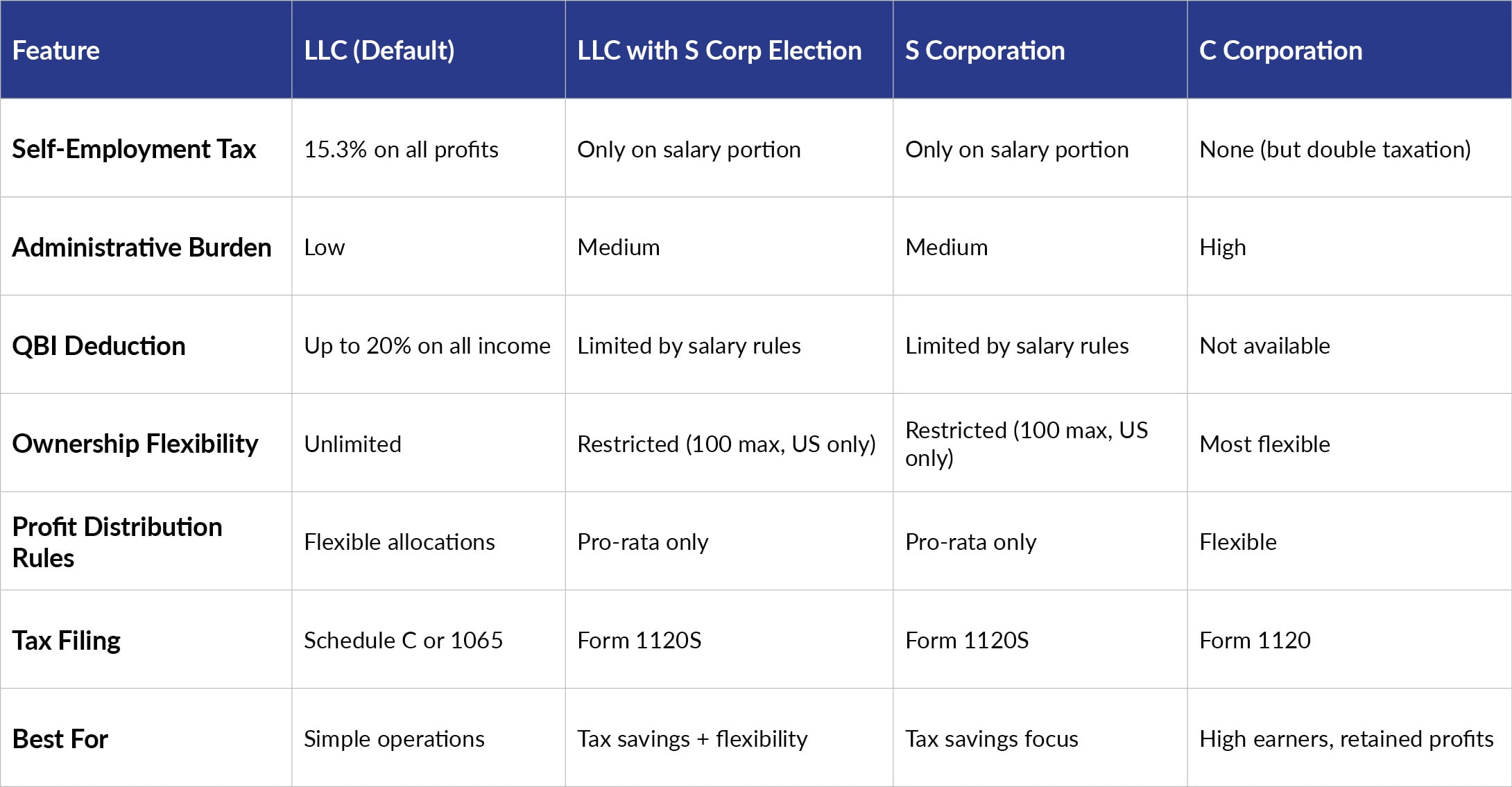
S Corp vs LLC Tax Treatment: The LLC offers flexibility but no self-employment tax savings. Every dollar of profit gets hit with the 15.3% SE tax. However, LLCs can elect S Corp status for taxes while maintaining LLC legal protections. Best of both worlds.
S Corp vs C Corp Considerations: C Corporations face double taxation (corporate level + personal level on dividends). However, they offer more tax planning opportunities for very high earners and those wanting to retain significant profits in the business.
The Section 199A (QBI) Factor: Here’s something that changed the game in 2018. The Qualified Business Income deduction allows eligible business owners to deduct up to 20% of their business income. S Corp owners can claim this deduction on both salary and distributions, but there are income limits and complications.
For S Corp owners, the QBI calculation can be tricky:
- Salary doesn’t qualify for QBI deduction
- Distributions do qualify (subject to limitations)
- W-2 wages paid by the S Corp can help overcome certain limitations
This means in some cases, paying higher salaries actually helps maximize your total deductions. The math gets complex, which is why I run detailed projections for each client.
S Corp Tax Reduction Strategies You Should Know
After working with hundreds of S Corp clients, I’ve identified the strategies that deliver the biggest impact. Let me walk you through the ones I implement most frequently.
Strategy #1: Family Employment Income Shifting
If you have children or a spouse who can legitimately work in your business, paying them reasonable wages shifts income to potentially lower tax brackets while creating legitimate business deductions.
Here’s how this strategy works in practice with a typical contractor scenario:
- Contractor hires two teenage children part-time for office work and job site cleanup
- Pays each child $6,000 annually (under standard deduction threshold)
- Creates $12,000 business deduction for the contractor
- Children pay zero income tax on their wages
- Total family tax savings: approximately $3,600 annually
Requirements for family wages:
- Work must be legitimate and necessary
- Wages must be reasonable for the work performed
- Proper documentation and payroll procedures required
- Children must actually perform the work
Strategy #2: Health Insurance Premium Deductions
S Corp owner-employees (2% or greater shareholders) get special treatment for health insurance. Premiums paid by the corporation are deductible business expenses but must be included in your W-2 wages. Then you can deduct them above-the-line on your personal return.
The process:
- Corporation pays health insurance premiums
- Amount gets added to your W-2 wages
- You claim corresponding deduction on Form 1040
- Net effect: business deduction with no additional personal income
This strategy works especially well for families with high healthcare costs. Business owners could potentially save $3,000-8,000 annually using this approach.
Strategy #3: Maximize Retirement Contributions
S Corp owners have access to powerful retirement savings vehicles that can dramatically reduce current taxes while building wealth.
Solo 401(k) for S Corps: If you’re the only employee, you can contribute both as employee and employer:
- Employee deferrals: up to $23,000 (2024 limits)
- Employer contributions: up to 25% of compensation
- Total possible contribution: up to $69,000 (more if age 50+)
SEP-IRA Alternative: Simpler administration but updated contribution limits for 2025. Employers can contribute up to 25% of eligible employee compensation, with a maximum contribution limit of $70,000 for 2025 (up from $69,000 in 2024). This plan remains a good option if you have employees, as contribution percentages must be equal for all participants. The maximum compensation considered for the 25% limit is capped at $350,000 in 2025.
Strategy #4: Section 179 and Bonus Depreciation
Equipment purchases offer immediate tax benefits through accelerated depreciation methods. Instead of spreading deductions over several years, you can often deduct the full cost in year one.
2024 Section 179 Limits:
- Up to $1,200,000 immediate deduction
- Phase-out begins at $3,050,000 in total purchases
- Must be business-use equipment
Bonus Depreciation:
- Bonus depreciation is permanently restored to 100% for qualified property acquired and placed in service after January 19, 2025.
- Property acquired on or before January 19, 2025, qualifies for 40% bonus depreciation in 2025.
- Can be combined with Section 179 expensing to maximize first-year deductions.
- Taxpayers may elect out or reduce bonus depreciation percentage for tax planning flexibility.
Example: Imagine a construction company purchased $85,000 in equipment. Using Section 179 to deduct the full amount saved approximately $25,500 in taxes (30% marginal rate). The tax savings helped fund the purchase.
New for 2025: SALT Deduction Workaround For S Corps
This is huge, and most accountants aren’t talking about it yet. The $10,000 state and local tax (SALT) deduction cap has hurt high earners in states like California, New York, and New Jersey. But S Corporations can potentially bypass this limitation.
How the SALT Workaround Works: Instead of deducting state income taxes on your personal return (subject to the $10,000 cap), your S Corporation pays state taxes at the entity level. These payments become business deductions with no federal limitations.
States Currently Allowing This Workaround:
- California
- Connecticut
- Georgia
- Illinois
- Louisiana
- New York
- Oklahoma
- Rhode Island
Example of SALT Savings: Consider an S Corp owner in New York with $15,000 in state income taxes:
- Old way: $10,000 personal deduction (capped) + $5,000 lost
- New way: $15,000 business deduction at entity level
- Additional federal tax savings: approximately $1,500-2,000
Important considerations:
- Must make entity-level election in participating states
- Timing of payments affects deduction year
- Some states require estimated payments
- Rules vary significantly by state
I’m helping qualifying clients implement this strategy for 2025 returns. The savings can be substantial if you’re in a participating state with high income taxes.
Smart Deductions: What S Corporations Can Write Off
One advantage of S Corp status is access to employee-type benefits and deductions that aren’t available to sole proprietors. Let me show you the ones that save my clients the most money.
Home Office Expenses for S Corp Owner-Employees
The home office deduction works differently for S Corp owners than other business structures. You have two options:
Option 1: Corporate Rental Arrangement
- S Corp rents space from you personally
- You report rental income and claim corresponding expenses
- Corporation deducts rent payments
- More complex but often yields better results
Option 2: Employee Business Expense (Limited)
- Claim unreimbursed employee business expenses
- Subject to 2% of AGI limitation
- Generally less favorable after tax law changes
I usually recommend the rental arrangement for clients with substantial home office use. The additional complexity pays off in most cases.
Auto Expenses and Vehicle Deductions
S Corp owners can deduct vehicle expenses using either actual cost or mileage methods. The corporation can also own vehicles and provide them to employees (including owner-employees).
Three approaches:
- Personal vehicle, business use: Track mileage or actual expenses
- Corporate-owned vehicle: All expenses deductible, personal use included in wages
- Reimbursement arrangement: Corporation reimburses employee for business use
For 2025, the IRS business mileage deduction rate is $0.70 per mile. If you’re driving 15,000 business miles annually, that translates to a $10,500 deduction.
Travel and Entertainment Deductions
Business travel remains fully deductible, but entertainment rules changed significantly. Here’s what still works:
Fully Deductible Travel:
- Transportation to business destinations
- Lodging away from home
- 50% of meals during business travel
- Conference and seminar costs
Entertainment (Limited):
- Business meals with clients: 50% deductible
- Employee holiday parties: 100% deductible
- Tickets to sporting events with clients: generally not deductible
Accountable Plan Requirements To make reimbursements non-taxable to employees (including owner-employees), establish an accountable plan with these elements:
- Business connection requirement
- Adequate accounting within reasonable time
- Return excess reimbursements
Without an accountable plan, reimbursements become taxable income to the employee.

S Corps And Charitable Giving
High-income S Corp owners often want to maximize charitable deductions while minimizing taxes. Here are strategies that work well for philanthropically-minded business owners.
Gifting Appreciated Stock If your S Corporation owns appreciated investments, gifting them to charity avoids capital gains taxes while providing charitable deductions. However, S Corp stock itself creates complications.
Problems with Gifting S Corp Stock Directly:
- Charity may not qualify as eligible S Corp shareholder
- Could inadvertently terminate S election
- Creates ongoing compliance issues
- Most charities won’t accept S Corp stock
Better Charitable Strategies: Instead of gifting S Corp stock, consider these alternatives:
Donor-Advised Funds:
- Contribute cash or other appreciated assets
- Immediate tax deduction
- Recommend grants to favorite charities over time
- Professional investment management
Charitable Remainder Trusts:
- Transfer appreciated assets to trust
- Receive income stream for life
- Remainder goes to charity at death
- Immediate charitable deduction based on remainder value
For example, an S Corp owner with highly appreciated real estate could establish a charitable remainder trust. This strategy could avoid $180,000 in capital gains taxes while creating a $400,000 income stream over 20 years.
When An S Corp Isn’t The Right Fit
Not everyone should elect S Corp status. After reviewing thousands of situations, here are the circumstances where I typically recommend against it.
Multistate Operations Create Complexity
S Corporations can trigger state tax filing requirements in multiple states, even without physical presence. Some states don’t recognize S Corp elections, creating additional tax burdens.
Problem scenarios:
- Clients or projects in multiple states
- Internet-based businesses serving nationwide customers
- Traveling service providers (contractors, consultants)
For these situations, I often recommend staying with LLC taxed as partnership or remaining sole proprietor until business operations stabilize geographically.
Foreign Investment or Ownership Issues
S Corps have strict ownership requirements that eliminate many business opportunities:
Prohibited shareholders:
- Non-resident aliens
- Corporations
- Partnerships
- Most trusts
- More than 100 total shareholders
If you’re considering foreign investors or planning complex ownership structures, C Corporation or LLC structures offer more flexibility.
Very High Revenue Situations
Counterintuitively, extremely profitable businesses sometimes benefit more from C Corporation status despite double taxation.
When C Corp might be better:
- Business profits consistently exceed $500,000
- Want to retain significant profits in business
- Plan to sell business (asset vs stock sale considerations)
- Need to provide extensive employee benefits
The math gets complex at high income levels, especially when considering state taxes and potential tax rate changes.
How To Set Up Your S Corporation For Maximum Tax Savings
The technical setup process is crucial for achieving your tax savings goals. Here’s a step-by-step approach for new S Corp elections.
Step 1: File Form 2553 Correctly and Timely
You must file Form 2553 within 75 days of forming your entity or by March 15th for calendar year elections. Late elections are possible but require additional paperwork and IRS approval.
Critical Form 2553 details:
- All shareholders must sign
- Specify effective date clearly
- Include spouse signature if filing joint returns
- Keep copies of all submitted documents
Step 2: Establish Proper Bookkeeping Systems
S Corps require more sophisticated record-keeping than sole proprietorships. You need to track:
Required S Corp records:
- Separate business bank accounts
- Detailed income and expense records
- Payroll records and tax deposits
- Shareholder basis tracking
- Corporate resolutions and minutes
I recommend QBO for most small S Corporations. It integrates well with payroll systems and handles the multi-entity accounting requirements.
Step 3: Set Up Payroll Processing
This is where many new S Corp owners stumble. You must run payroll for owner-employees, including:
- Federal income tax withholding
- FICA taxes (Social Security and Medicare)
- State income tax withholding
- Quarterly Form 941 filings
- Annual Forms W-2 and W-3
Payroll processing options:
- DIY with software: QuickBooks Payroll, ADP, Paychex
- Professional payroll service: Full-service providers handle everything
- CPA-managed payroll: We handle payroll for many clients
For most small S Corps, professional payroll service makes sense. The cost (typically $50-150/month) is usually less than the time and stress of doing it yourself.
Step 4: Implement Year-Round Tax Planning
The biggest S Corp tax savings come from proactive planning throughout the year, not just at filing time.
Quarterly planning activities:
- Review salary vs distribution split
- Project annual income for tax planning
- Evaluate equipment purchase timing
- Assess retirement contribution opportunities
I meet with S Corp clients quarterly to review these items. It’s the difference between reactive tax preparation and proactive tax planning.
Get Expert Help With Advanced S Corp Tax Planning
Here’s what I’ve learned after 15 years in tax planning: software and DIY approaches work fine for simple situations. But S Corp tax strategies require expertise that goes beyond basic tax preparation.
Why professional help matters for S Corp owners:
- Complex compliance requirements: S Corps have filing obligations that sole proprietors don’t face. Form 1120S, payroll taxes, and state requirements create multiple failure points.
- Advanced planning opportunities: The strategies I’ve outlined require careful implementation and ongoing management. One mistake can eliminate years of tax savings.
- Audit protection: S Corp returns get scrutinized more carefully than simpler returns. Professional preparation with proper documentation provides crucial audit protection.
- Ongoing optimization: Tax laws change constantly. What worked last year may not be optimal for this year. Professional management adapts strategies as circumstances change.
At Interactive Accountants, we specialize in helping business owners implement these advanced S Corp tax strategies. Our clients typically save 3-5 times our fees in additional tax benefits we identify and implement.
Our S Corp tax services include:
- Annual S Corp tax return preparation and filing
- Quarterly tax planning and strategy sessions
- Payroll processing and compliance management
- Multi-state filing when required
- Audit representation and support
- Business entity optimization reviews
Contact us today to schedule an S Corp tax strategy consultation. We’ll review your specific situation and show you exactly how much you could save with proper S Corp tax planning.
We also provide comprehensive business tax services beyond S Corp planning, including entity selection, succession planning, and advanced tax strategies for growing businesses.
For additional tax-saving ideas, download our ultimate tax deduction list – a comprehensive guide covering over 200 legitimate business deductions most owners miss.
FAQs
What are the top tax benefits of an S Corporation?
The primary benefit is avoiding self-employment tax on business distributions. Instead of paying 15.3% SE tax on all business income, S Corp owners only pay it on their salary. Additional benefits include access to employee benefits, retirement plan options, and certain business deductions not available to sole proprietors.
What are considered legitimate S Corporation tax deductions?
S Corporations can deduct all ordinary and necessary business expenses, including: salaries and benefits, rent, equipment, supplies, professional services, travel, meals (50%), home office expenses (through proper arrangements), auto expenses, and health insurance for owner-employees. The key is maintaining proper documentation and business purpose.
How does an S Corp save money on self-employment tax?
By splitting business income between salary (subject to payroll taxes) and distributions (not subject to self-employment tax). For example, if your business earns $150,000, you might pay yourself $70,000 salary and take $80,000 as distributions, saving approximately $12,240 in self-employment taxes annually.
What is the SALT workaround for S Corps?
The SALT workaround allows S Corporations in participating states to pay state income taxes at the entity level, creating unlimited federal business deductions. This bypasses the $10,000 SALT deduction cap on personal returns. Currently available in states like California, New York, Connecticut, and others.
What is the difference between S Corp and LLC tax treatment?
LLCs are subject to self-employment tax on all business income, while S Corp distributions avoid this tax. However, LLCs offer more flexibility in profit sharing, don’t require payroll processing, and have fewer ownership restrictions. LLCs can elect S Corp tax treatment to get both benefits.
Can you donate S Corp stock to charity?
Generally not recommended. Most charities don’t qualify as eligible S Corp shareholders, and accepting S Corp stock could inadvertently terminate the S election. Better strategies include donating other appreciated assets, using donor-advised funds, or establishing charitable remainder trusts.
When is an S Corp not a good idea?
S Corps aren’t ideal for: businesses with multistate operations (complex state tax issues), those wanting foreign investors (ownership restrictions), very low income businesses (administrative costs exceed benefits), or those planning complex ownership structures. The administrative burden and costs must justify the tax savings.