


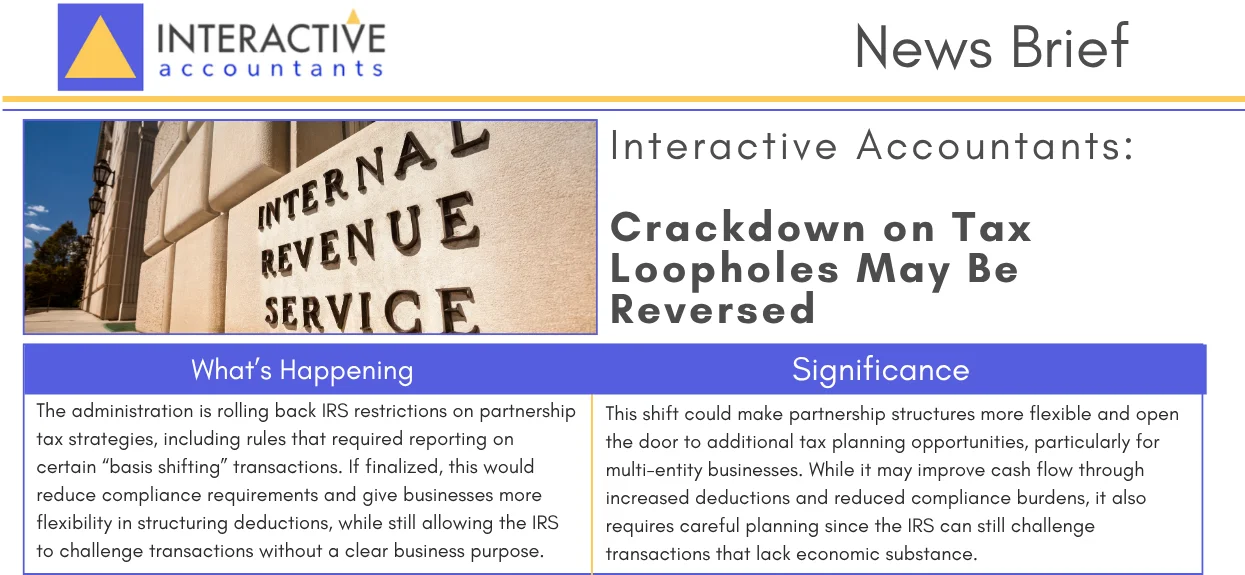
Crackdown on Tax Loopholes May Be Reversed

Recent Blog Post

What Business Owners Need to Know Right Now

A significant shift in federal tax policy is underway that could reshape how many businesses approach partnership structures, asset allocation, and tax planning heading into 2026.

The administration is moving to roll back restrictions that targeted certain partnership tax strategies, particularly those involving “basis shifting.” These strategies generally involve transferring assets between related entities in a way that increases depreciation deductions and reduces taxable income.

Under prior rules, the IRS required enhanced reporting and placed greater scrutiny on these transactions to limit what it viewed as aggressive tax planning. The goal was to ensure that deductions reflected genuine economic activity rather than internal structuring designed primarily for tax benefits.

Now, those restrictions may be eliminated. Regulators have indicated that the rules were overly complex, difficult to enforce, and created unnecessary compliance burdens for businesses. If finalized, this rollback would remove reporting requirements and effectively reopen planning flexibility that many businesses had previously scaled back or avoided.

Why This Is Happening

This change reflects a broader shift toward a more business-friendly regulatory and tax environment. Policymakers are placing increased emphasis on reducing administrative burden and encouraging investment, particularly for businesses that rely on capital assets and layered entity structures.

At the same time, there has been ongoing criticism that prior rules were too broad, capturing legitimate transactions alongside more aggressive ones. As a result, the focus appears to be shifting away from strict reporting requirements and toward relying on existing enforcement doctrines rather than prescriptive rules.

What This Looks Like in Practice

To understand the concept, consider a simplified example.

A business owns equipment in one entity and transfers that asset to a related entity that generates taxable income. Under certain structures, this transfer can reset or accelerate depreciation schedules, creating additional deductions in the receiving entity.

These types of internal reorganizations, when done with a proper business purpose, have been used as part of broader tax planning strategies. The prior rules aimed to require disclosure and limit repeated use of these techniques across related entities.

With the rollback, some of those reporting requirements may no longer apply, potentially giving businesses more flexibility in how they structure internal transactions.

The Impact on Business Owners

This change is particularly relevant for businesses operating with multiple entities or partnership structures, including real estate investors, healthcare groups, logistics operators, and professional service firms.

For these businesses, the potential benefits may include:

  • Increased flexibility in structuring asset ownership and transfers
  • Opportunities to accelerate depreciation and improve near-term deductions
  • Improved cash flow through more efficient tax positioning
  • The ability to revisit strategies that were previously set aside due to compliance complexity

In practical terms, this could translate into meaningful tax savings depending on the size of the business and the nature of its assets.

What Business Owners Need to Know

Despite the rollback, this does not eliminate risk.

The IRS continues to rely on long-standing principles such as the economic substance doctrine. This means transactions must have a legitimate business purpose beyond tax reduction. Internal transfers that exist solely to generate deductions without real operational justification can still be challenged.

It is also important to note that regulatory changes are still evolving. Final guidance has not been fully established, and timing around implementation may affect planning decisions.

What You Can Do Now

This is a planning moment, not a reaction moment.

Business owners should begin by reviewing their current entity structure and identifying areas where asset placement, ownership, or intercompany transactions could be optimized. For some, this may involve revisiting strategies that were previously paused due to stricter compliance requirements.

Next, run forward-looking scenarios to understand how different structures could impact tax liability and cash flow in 2026 and beyond. The goal is to align tax strategy with actual business operations, not to separate the two.

Finally, work closely with your tax advisor before making any structural changes. Documentation, intent, and alignment with business activity will remain critical if strategies are ever examined.

Bottom Line

This policy shift signals a return to greater flexibility in partnership tax planning, but not a departure from scrutiny.

For business owners, the opportunity is real, but so is the responsibility to implement strategies thoughtfully. Those who act early, plan carefully, and tie tax decisions to legitimate business operations will be best positioned to benefit from this changing environment.

Share on:

Posted on Google Google
Tyler Kremberg profile picture
Tyler Kremberg
Google star 1Google star 2Google star 3Google star 4Google star 5Trustindex verifies that the original source of the review is Google.
Everyone we've worked with at Interactive Accounts has been great. Always prompt and thorough in answering our questions and very detail-oriented when completing our documents. We've been using them for years and plan to continue.
Posted on Google Google
Vincent Scire profile picture
Vincent Scire
Google star 1Google star 2Google star 3Google star 4Google star 5Trustindex verifies that the original source of the review is Google.
⭐⭐⭐⭐⭐ I highly recommend Interactive Accounts. They have become a trusted financial partner to me and DriVin Logistics, providing a level of support that goes well beyond traditional accounting and bookkeeping. Their team provides corporate-level financial consulting that helps me better understand the financial health of my business and make informed decisions as we continue to grow. In addition to managing our accounting and bookkeeping needs, they provide valuable business tax guidance and services, helping ensure that we are planning ahead rather than simply reacting at tax time. What I appreciate most is their ability to look at the bigger picture. They take the time to understand my business, where we are today, and where we are trying to go. Their professionalism, responsiveness, attention to detail, and willingness to provide guidance have given me tremendous confidence in our financial management. Because of the experience I’ve had with them through DriVin Logistics, I am also expanded our relationship to include personal tax guidance and services. That speaks volumes about the level of trust they have earned. If you are a business owner looking for more than just someone to handle the books—someone who can serve as a knowledgeable, proactive financial partner—I strongly recommend Interactive Accounts. Five stars without hesitation!
Posted on Google Google
Diego Perez profile picture
Diego Perez
Google star 1Google star 2Google star 3Google star 4Google star 5Trustindex verifies that the original source of the review is Google.
I have been working with Matt and his team for years now. Extremely knowledgable, professional, and dedicated team. I am grateful for their help and guidance!
Posted on Google Google
Terelle Arnett profile picture
Terelle Arnett
Google star 1Google star 2Google star 3Google star 4Google star 5Trustindex verifies that the original source of the review is Google.
They were efficient and great to work with!
Posted on Google Google
Trace Cox profile picture
Trace Cox
Google star 1Google star 2Google star 3Google star 4Google star 5Trustindex verifies that the original source of the review is Google.
Never been so happy with a accountant firm . Don’t need to ask or what on anything. They are ontop of everything. They make business a pleasure!!
Posted on Google Google
Tim Costello profile picture
Tim Costello
Google star 1Google star 2Google star 3Google star 4Google star 5Trustindex verifies that the original source of the review is Google.
Fast professional and strong customer service
Posted on Google Google
Massimo Corghi profile picture
Massimo Corghi
Google star 1Google star 2Google star 3Google star 4Google star 5Trustindex verifies that the original source of the review is Google.
They are awesome.

Online Accounting and Tax Services

Located in the heart of Doral, Florida, Interactive Accountants serves businesses across the nation. Our virtual services make it easy to connect with our team and get the support you need, wherever you are.

Florida Location

New Jersey Location

Question & Answers

Still have some questions? Let us know how we can help you.

Our CTO (Chief Tax Officer) program provides proactive tax planning and strategic advice to help high-income individuals and business owners minimize their tax liability and maximize their wealth.

We serve various industries, including law firms, healthcare, e-commerce, restaurants, and Amazon delivery partners.

You can get started by scheduling a discovery call with our team to discuss your needs and how we can help.

Yes! While we’re based in Doral, Florida, we serve clients nationwide through our secure virtual platform and interactive client portal.

We use industry-leading platforms including TaxDome, QuickBooks Online, and Drake Tax Software to ensure efficient and accurate service.

Let's Get Interactive With Your Finances!

Explore our CTO program and experience the difference of having a dedicated Chief Tax Officer on your team.

Scroll to Top

Before You Go, Find Out How Much You May Be Overpaying.

Book a complimentary 15-minute Savings Audit to identify potential tax leakage and capital recovery opportunities.

Interactive Accountants founder Matthew Shiebler, CPA. Expert in tax planning and accounting for national clients

We analyze your books to identify accounting errors, tax saving opportunities, and financial strategies to save you money.