


The power of real estate tax strategies becomes clear when you run the numbers. Consider a typical scenario: an investor with three rental properties paying $47,000 in taxes annually. After implementing the right strategies, that same tax bill could drop to $12,000. Same properties, same income, completely different tax outcome.
That’s the power of understanding how real estate tax planning really works. Most property investors are leaving tens of thousands on the table every year simply because they don’t know what’s available to them.
Here’s what frustrates me: I see smart, successful real estate investors paying way more taxes than necessary because they treat real estate like any other investment. It’s not. Real estate comes with some of the most powerful tax strategies for real estate investors in the entire tax code – but only if you know how to use them.
Today I’m going to show you the exact strategies that can transform your tax situation. We’ll cover everything from basic deductions to advanced techniques. By the end, you’ll understand how to structure your real estate investments for maximum tax efficiency.

Core Real Estate Tax Strategies Every Investor Should Know
The foundation of successful real estate tax strategies starts with understanding that real estate gets special treatment under tax law. Unlike stocks or bonds, real estate investments offer multiple layers of tax benefits that compound over time.
The Big Three Foundation Strategies
- Depreciation Deductions: You can deduct the cost of your investment properties over 27.5 years (residential) or 39 years (commercial), even while the property appreciates in value. This creates paper losses that offset real income.
- Passive Loss Rules: Understanding these rules is critical. If your adjusted gross income is under $100,000 and you actively participate in managing your rentals, you can deduct up to $25,000 in rental losses against other income.
- Capital Gains Deferral: Through various strategies, you can defer or sometimes eliminate capital gains taxes when selling properties, keeping more money working for you.
Here’s where most people mess up: they think of these strategies as separate tools. They’re not. The real power comes from combining them systematically over time.
Active vs Passive Participation – Critical Distinction
The IRS defines active participation as making management decisions like approving tenants, setting rental terms, and approving repairs. You don’t have to physically manage the property yourself – you can hire a property manager and still qualify.
Active participation benefits:
- Deduct up to $25,000 in losses against other income
- Qualify for certain tax elections
- Access to real estate professional status (if applicable)
Passive activity limitations:
- Losses only offset passive income
- Unused losses carry forward indefinitely
- Limited deduction opportunities
Most investors qualify for active participation without realizing it. Make sure you document your management activities to support this classification.
1031 Exchanges & Qualified Opportunity Zones
These two strategies represent some of the most powerful wealth-building tools in real estate tax planning. Let me break down how each works and when to use them.
1031 Tax-Deferred Exchanges
A 1031 exchange lets you sell investment property and buy replacement property without paying capital gains taxes. The taxes aren’t forgiven – they’re deferred until you eventually sell without exchanging.
1031 Exchange Requirements:
- Both properties must be held for investment or business use
- Properties must be “like-kind” (very broad definition for real estate)
- Must identify replacement property within 45 days
- Must close on replacement property within 180 days
- Must use qualified intermediary to hold funds
Three identification rules (you must follow one):
- 3-Property Rule: Identify up to 3 properties regardless of value
- 200% Rule: Identify any number of properties worth up to 200% of sold property value
- 95% Rule: Identify any number of properties but must close on 95% of identified value
Possible Example: You sell a duplex for $400,000 with $150,000 in capital gains. Instead of paying $30,000-45,000 in taxes, you exchange into a $400,000 fourplex. Your basis transfers to the new property, and you keep that $30,000+ working for you.
Qualified Opportunity Zones
This newer strategy offers incredible tax benefits for long-term investors willing to invest in designated economically distressed areas.
Opportunity Zone Benefits:
- Defer capital gains taxes until 2026
- Reduce deferred gains by 10% if held 5+ years
- Eliminate all taxes on Opportunity Zone investment gains if held 10+ years
How it works:
- Sell any asset and realize capital gains
- Invest gains into Qualified Opportunity Zone Fund within 180 days
- Hold investment for specified periods to receive benefits
The 10-year tax-free growth benefit is powerful. If you invest $100,000 in gains and the Opportunity Zone investment doubles over 10 years, you pay zero taxes on that $100,000 growth.
Mortgage Interest, Maintenance, And Property Tax Deductions
This is where your day-to-day real estate tax strategies generate consistent savings. These deductions reduce your taxable rental income dollar-for-dollar.
Fully Deductible Operating Expenses
- Mortgage interest on investment properties (no $750,000 limit like personal residences)
- Property taxes
- Insurance premiums
- Property management fees
- Repairs and maintenance
- Professional services (legal, accounting, property management)
- Advertising for tenants
- Travel expenses for property management
Repair vs Improvement – Critical Distinction
Repairs (fully deductible immediately):
- Fixing leaky faucets
- Repainting rooms
- Replacing broken windows
- Patching roof leaks
Improvements (must be capitalized and depreciated):
- Adding new rooms
- Installing new roof
- Upgrading HVAC system
- Major kitchen renovation
When in doubt, err on the side of calling it a repair if the work restores the property to its previous condition rather than improving it.
Passive Loss Rules in Action
Here’s how the passive loss rules work with an example:
Scenario: Let’s say you earn $80,000 from your job and own a rental property that shows a $15,000 loss after expenses and depreciation.
If you actively participate:
- Deduct the full $15,000 loss against your job income
- Reduces taxable income to $65,000
- Tax savings: approximately $3,600 (24% bracket)
If you don’t actively participate:
- Loss only offsets passive income
- If no passive income, loss carries forward
- No immediate tax benefit
Document your active participation activities. Keep records of tenant screening, repair approvals, and management decisions.
House Hacking And Section 121 Exclusion
House hacking combines investment strategy with personal tax benefits. You live in a multi-unit property, rent out the other units, and qualify for both rental property deductions and homeowner benefits.
House Hacking Tax Advantages:
- Deduct expenses for rental portions
- Claim depreciation on investment portion
- Qualify for homeowner mortgage interest deduction
- Build equity through tenant rent payments
Section 121 Exclusion for Primary Residences
If you live in a property for 2 of the 5 years before selling, you can exclude up to $250,000 in capital gains ($500,000 married filing jointly) from federal taxes.
Strategic house hacking approach:
- Buy duplex, live in one unit for 2+ years
- Rent out second unit, claim rental deductions
- Move out, rent both units for up to 3 years
- Sell and use Section 121 exclusion on portion used as residence
- Use 1031 exchange on investment portion
This strategy can eliminate capital gains taxes on a significant portion of your property while building wealth through rental income.
House Hacking Record-Keeping:
Track expenses by percentage of personal vs rental use:
- Mortgage interest splits between Schedule A and Schedule E
- Property taxes allocated proportionally
- Maintenance expenses allocated to rental portion
- Utilities split based on actual usage
Use QBO or similar software to track these allocations automatically. Proper record-keeping is essential for audit protection.
Turbocharge Deductions With Cost Segregation
Cost segregation is the single most powerful real estate tax planning strategy most investors have never heard of. It accelerates depreciation deductions by reclassifying parts of your property as shorter-life assets.
How Cost Segregation Work
Instead of depreciating your entire $500,000 rental property over 27.5 years, a cost segregation study might identify:
- $400,000 in building structure (27.5 years)
- $50,000 in carpeting and fixtures (5 years)
- $30,000 in land improvements (15 years)
- $20,000 in personal property (5 years)
Result: Much larger depreciation deductions in early years, improving cash flow significantly.
Cost Segregation Benefits:
- Accelerate $10,000-50,000+ in deductions to current year
- Improve cash flow through reduced taxes
- Create additional losses to offset other income
- No extra taxes later – you’re just moving deductions forward in time
Engineering-Based Studies vs Component Method
Professional cost segregation studies involve engineers who inspect the property and identify all components eligible for accelerated depreciation. These studies cost $5,000-15,000 but generally generate $20,000-100,000+ in accelerated deductions.
Retroactive Cost Segregation (Form 3115)
Here’s something most investors don’t know: you can apply cost segregation retroactively to properties you’ve owned for years using Form 3115, Application for Change in Accounting Method.
Catch-Up Depreciation Process:
- Complete cost segregation study for existing property
- File Form 3115 with current year tax return
- Claim all “missed” depreciation as Section 481(a) adjustment
- Take entire catch-up deduction in current year (usually)
Imagine a real estate investor with a $600,000 property bought 3 years ago might claim an additional $40,000 deduction in the current year through this process.
When Cost Segregation Makes Sense
- Property cost exceeds $500,000
- You have other income to offset with additional deductions
- Property was recently purchased or improved
- You plan to hold property for several years
The analysis is simple: if the study costs $10,000 and generates $50,000 in accelerated deductions, you’re saving $15,000+ in taxes (30% marginal rate) for a net benefit of $5,000+ immediately.
Use Installment Sales To Defer Capital Gains Taxes
Installment sales let you spread capital gains taxes over multiple years, potentially keeping you in lower tax brackets and reducing overall tax burden.
How Installment Sales Work
Instead of receiving full sale price at closing, you finance part of the purchase for the buyer. You receive payments over several years and only pay capital gains taxes as payments are received.
Example: You sell a property for $800,000 with $300,000 in capital gains.
Traditional sale:
- Receive $800,000 at closing
- Pay capital gains tax on $300,000 in current year
- Tax bill: approximately $60,000-90,000
Installment sale:
- Receive $200,000 down payment
- Finance $600,000 over 10 years at 6% interest
- Pay capital gains tax on $75,000 per year (25% of each payment)
- Annual tax bill: $15,000-22,500
Installment Sale Benefits:
- Spread income over multiple years
- Potentially stay in lower tax brackets
- Earn interest on financed amount
- Defer large tax bills to improve cash flow
IRS Rules and Limitations:
- Must receive at least one payment in tax year after sale year
- Can’t use installment method for dealer/flipper sales
- Depreciation recapture is taxed in year of sale (can’t defer)
- Buyer must be creditworthy for financing arrangement
Strategic Installment Sale Planning:
Consider installment sales when:
- Sale would push you into higher tax brackets
- You need steady income stream
- Buyer needs financing assistance
- You want to maintain some real estate exposure
The interest rate should be at least the Applicable Federal Rate (AFR) to avoid imputed income issues.

Use DSTs Smartly In Tax-Deferred Planning
Delaware Statutory Trusts (DSTs) solve a major problem with 1031 exchanges: finding suitable replacement properties within tight deadlines.
What are DSTs
DSTs are pre-packaged real estate investments that qualify as like-kind property for 1031 exchanges. Professional sponsors buy institutional-grade properties (office buildings, apartments, retail centers) and sell fractional interests to investors.
DST Advantages
- No property management responsibilities
- Professional asset management
- Access to institutional-grade properties
- Potential for steady income distributions
- Qualify for 1031 exchanges
How DSTs Work with 1031 Exchanges
- Sell your rental property
- Identify DST properties within 45 days
- Exchange proceeds into DST interests
- Receive quarterly distributions from DST
- Defer capital gains taxes
DST Investment Example
You sell a $500,000 duplex and want to exchange into DSTs. You might:
- Invest $200,000 in a multifamily DST
- Invest $200,000 in a medical office DST
- Invest $100,000 in a retail DST
Each DST provides different risk/return profiles and geographic diversification.
Managing Depreciation Recapture with DSTs
DSTs generate depreciation pass-through to investors, which creates future depreciation recapture obligations. When the DST eventually sells its property, you’ll have recapture income.
Planning strategies:
- Reinvest DST sale proceeds into new DSTs (another 1031 exchange)
- Hold DSTs until death to get stepped-up basis
- Plan for recapture income in retirement years with lower tax rates
DST Risks and Considerations:
- Limited control over investment decisions
- Fees can be substantial (8-12% of investment)
- Illiquid investment (typically 5-10 year hold periods)
- Quality varies significantly among sponsors
DSTs work best for investors who want passive real estate exposure while maintaining 1031 exchange benefits.
Multiply SALT Deductions Using Non-Grantor Trust Stacking
The $10,000 state and local tax (SALT) deduction limitation hits high-income real estate investors particularly hard. Property taxes alone often exceed this limit, not including state income taxes.
Non-grantor trust stacking offers a legal workaround for investors in high-tax states.
How Trust Stacking Works
Instead of owning rental properties personally, you transfer them to multiple non-grantor trusts. Each trust files its own tax return and gets its own $10,000 SALT deduction.
Example: You own 4 rental properties in California with $15,000 each in property taxes ($60,000 total).
Without trust stacking:
- Personal SALT deduction: $10,000
- Non-deductible property taxes: $50,000
- Lost tax benefit: approximately $20,000
With trust stacking:
- 4 trusts, each owning one property
- Each trust deducts $15,000 in property taxes
- Total SALT deductions: $60,000
- Tax savings: approximately $20,000+ annually
Non-Grantor Trust Requirements:
- Trust must have independent trustee
- Beneficiaries can’t have too much control
- Trust must have legitimate business purpose
- Proper legal documentation essential
Trust Stacking Considerations
Benefits:
- Multiply SALT deductions legally
- Potential estate planning benefits
- Creditor protection advantages
- Privacy benefits
Drawbacks:
- Complex setup and administration
- Annual trust tax return filing costs
- Loss of direct control over properties
- Higher tax rates on retained trust income
This strategy works best for investors with substantial property tax bills in high-tax states. The setup costs and complexity must be justified by tax savings.
Optimize Asset Location & Entity Structuring
How you hold your real estate investments affects taxes dramatically. The wrong structure can cost thousands annually in unnecessary taxes and missed opportunities.
Single-Member LLC (Default: Disregarded Entity)
Most basic structure for rental property ownership:
- No separate tax return required
- Report income/losses on Schedule E
- No self-employment tax on rental income
- Simple bookkeeping and compliance
When single-member LLCs make sense:
- 1-3 rental properties
- Straightforward rental operations
- Want simplicity over optimization
Multi-Member LLC (Partnership Tax Treatment)
When you have partners or want more sophisticated tax planning:
- Files Form 1065 partnership return
- Pass-through taxation to members
- Flexible profit/loss allocations
- Special allocations possible
Partnership benefits:
- Share expenses and deductions among members
- Allocate depreciation to high-income members
- Flexible distribution arrangements
S Corporation Election for Real Estate
Rarely optimal for rental real estate because:
- Rental income isn’t subject to self-employment tax anyway
- Adds payroll tax compliance
- Restricts profit allocations
- No significant benefits for passive rental income
C Corporation Structure
Sometimes beneficial for active real estate businesses:
- Real estate development companies
- Property management businesses
- Large-scale fix-and-flip operations
C Corp benefits:
- Retain earnings at lower corporate tax rates
- More employee benefit options
- Better for raising capital
Asset Location Strategy
Hold different types of real estate in appropriate structures:
- Rental properties: LLCs or direct ownership
- Fix-and-flip properties: S Corp or C Corp (active business income)
- Real estate development: C Corp (large projects)
- Real estate syndications: Partnership structures
Self-Employment Tax Planning
Rental income isn’t subject to self-employment tax, but related activities might be:
- Property management services: subject to SE tax
- Real estate agent commissions: subject to SE tax
- Construction/renovation services: subject to SE tax
Structure these activities in entities that minimize self-employment taxes while keeping passive rental income separate.
Combine Strategies For Compounding Tax Benefits
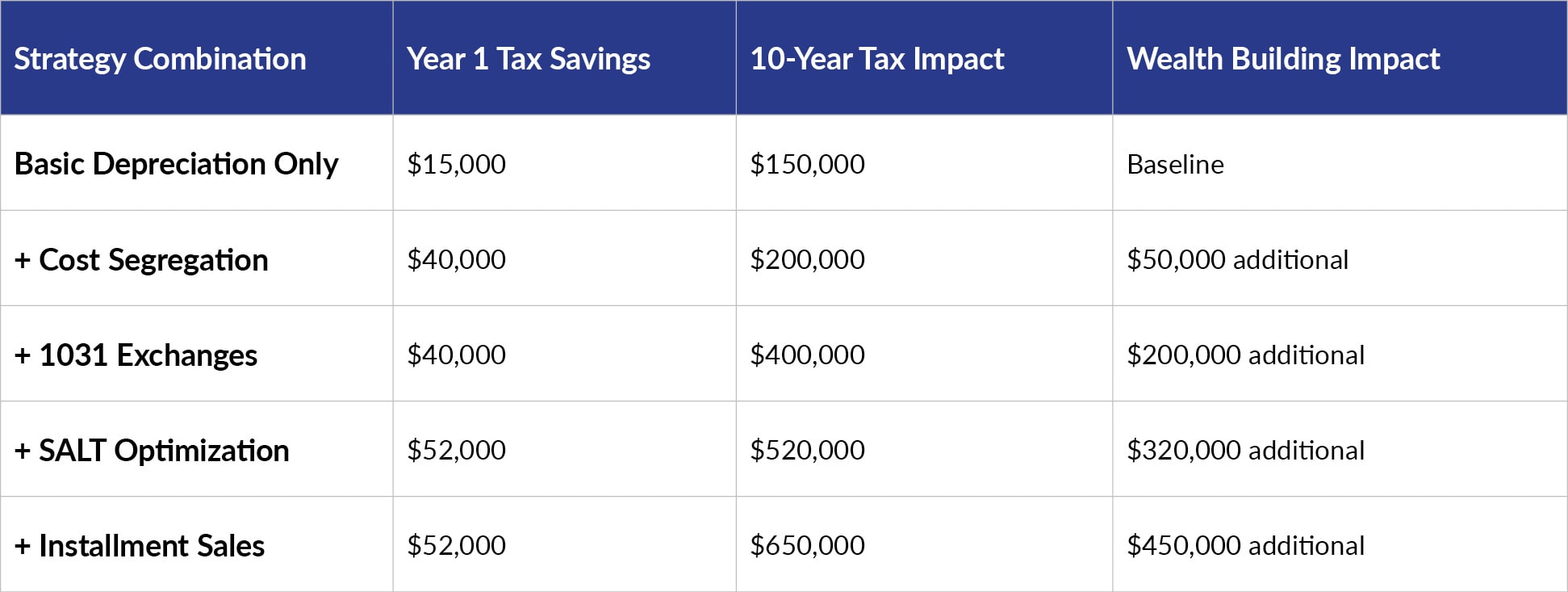
The real power of real estate tax strategies comes from combining multiple approaches systematically. Let me show you how investors build wealth by stacking these strategies.
Case Study: Multi-Strategy Approach
Let’s imagine an investor with $2 million in real estate equity looking to optimize taxes and build wealth:
Year 1: Cost Segregation + Entity Optimization
- Complete cost segregation studies on existing properties
- Generate $80,000 in additional depreciation deductions
- Tax savings: approximately $24,000 (30% marginal rate)
- Restructure holdings into separate LLCs for liability protection
Year 2: Strategic Property Sale + 1031 Exchange
- Sell one property with $300,000 capital gains
- 1031 exchange into larger property in Opportunity Zone
- Defer $60,000+ in capital gains taxes
- Begin 10-year hold period for tax-free OZ gains
Year 3: SALT Optimization + Trust Stacking
- Implement non-grantor trust stacking for high-tax state properties
- Increase SALT deductions from $10,000 to $40,000
- Annual tax savings: approximately $12,000
Year 5: Installment Sale Strategy
- Sell property using installment sale method
- Spread $400,000 gain over 8 years
- Stay in lower tax brackets throughout retirement
- Reduce total tax burden by approximately $30,000
Cumulative Results Over 10 Years:
- Tax savings: $200,000+
- Deferred taxes: $500,000+
- Additional wealth building capacity: $700,000+
Sequential Strategy Implementation
Years 1-2: Foundation Building
- Optimize current holdings with cost segregation
- Implement proper entity structures
- Begin systematic record-keeping
Years 3-5: Growth Phase
- Use 1031 exchanges for portfolio expansion
- Implement SALT optimization strategies
- Add Opportunity Zone investments
Years 6-10: Wealth Preservation
- Begin strategic exit planning
- Use installment sales for tax-efficient exits
- Implement estate planning strategies
The key is implementing strategies systematically rather than randomly. Each strategy builds on previous ones to create compounding tax benefits.
Maintain Compliance: Working With Real Estate Tax Experts
Real estate tax planning involves complex rules with significant penalties for mistakes. Professional guidance isn’t optional – it’s essential for protecting your wealth and maximizing benefits.
Critical Documentation Requirements
Cost Segregation Studies:
- Must be prepared by qualified engineers
- Detailed component analysis required
- Site inspections and blueprints necessary
- IRS audit protection through proper documentation
1031 Exchange Documentation:
- Qualified intermediary agreements
- Identification notices within 45 days
- Exchange agreements and assignments
- Timeline compliance documentation
Trust Documentation:
- Proper trust agreements and amendments
- Independent trustee arrangements
- Business purpose documentation
- Annual compliance and filings
Common Compliance Mistakes
- Mixing personal and rental expenses: Keep separate bank accounts and credit cards for rental properties. Personal use of rental property creates taxable income and disallows deductions.
- Poor record-keeping: Track all expenses, improvements, and depreciation taken. You’ll need this information for future sales, cost segregation studies, and potential audits.
- Missing deadlines: 1031 exchanges have non-extendable deadlines. Cost segregation elections have specific filing requirements. Missing deadlines eliminates tax benefits permanently.
Choosing the Right Tax Professional
Look for professionals with specific real estate tax expertise:
- CPA with real estate specialization
- Experience with advanced strategies (cost segregation, 1031 exchanges, trust planning)
- Proactive planning approach, not just compliance
- Technology integration for efficient record-keeping
Red flags in tax professionals
- Promises unrealistic tax savings
- Lack of specific real estate experience
- Reactive approach (only works during tax season)
- Poor communication and responsiveness
At Interactive Accountants, our comprehensive business tax services include specialized real estate tax planning. We work with property investors year-round to implement and maintain these advanced strategies.
Ongoing Strategy Management
Successful real estate tax strategies require regular review and adjustment:
- Annual strategy sessions to evaluate new opportunities
- Quarterly check-ins for compliance monitoring
- Market change adaptations (tax law updates, property values)
- Life event planning (retirement, estate planning, major purchases)
Contact us to schedule your real estate tax strategy review. We’ll analyze your current situation and identify opportunities you’re missing.
For additional deduction opportunities beyond real estate, download our ultimate tax deduction guide.
FAQs
What are the most effective tax strategies for real estate investors?
The most impactful strategies are: 1) Cost segregation to accelerate depreciation, 2) 1031 exchanges to defer capital gains, 3) Proper entity structuring to optimize deductions, and 4) Strategic use of passive loss rules. Combined properly, these can save tens of thousands annually while building long-term wealth.
Can cost segregation be done retroactively for past property purchases?
Yes, using Form 3115 (Application for Change in Accounting Method). You can apply cost segregation retroactively and claim all “missed” accelerated depreciation as a catch-up deduction in the current year. This often generates substantial immediate tax savings for properties owned several years.
How do installment sales help with real estate tax planning?
Installment sales spread capital gains over multiple years instead of recognizing them all at once. This can keep you in lower tax brackets, reduce Medicare surtaxes, and improve cash flow by deferring large tax bills. You also earn interest on the financed portion of the sale.
What is a DST, and how does it help with 1031 exchanges?
Delaware Statutory Trusts (DSTs) are pre-packaged real estate investments that qualify for 1031 exchanges. They solve the problem of finding replacement properties within 1031 deadlines while providing professional management and institutional-grade property access. You get 1031 benefits without direct property management responsibilities.
How can I maximize SALT deductions under the current tax law?
Non-grantor trust stacking allows multiple $10,000 SALT deductions by holding properties in separate trusts. Each trust gets its own deduction, effectively multiplying your SALT benefits. This works best for investors with substantial property taxes in high-tax states.
Why is entity structure important for real estate investments?
Entity structure affects taxes, liability protection, and operational flexibility. The wrong structure can cost thousands in unnecessary taxes or missed opportunities. LLCs typically work best for rental properties, while active real estate businesses might benefit from S Corp or C Corp structures.
How can combining multiple strategies amplify tax savings?
Strategies create compounding benefits when implemented systematically. Cost segregation generates immediate deductions, 1031 exchanges defer gains for reinvestment, and trust stacking multiplies SALT benefits. Combined properly over time, these strategies can save hundreds of thousands in taxes while accelerating wealth building.