


What Business Owners Need to Know Right Now
A significant shift in federal tax policy is underway that could reshape how many businesses approach partnership structures, asset allocation, and tax planning heading into 2026.
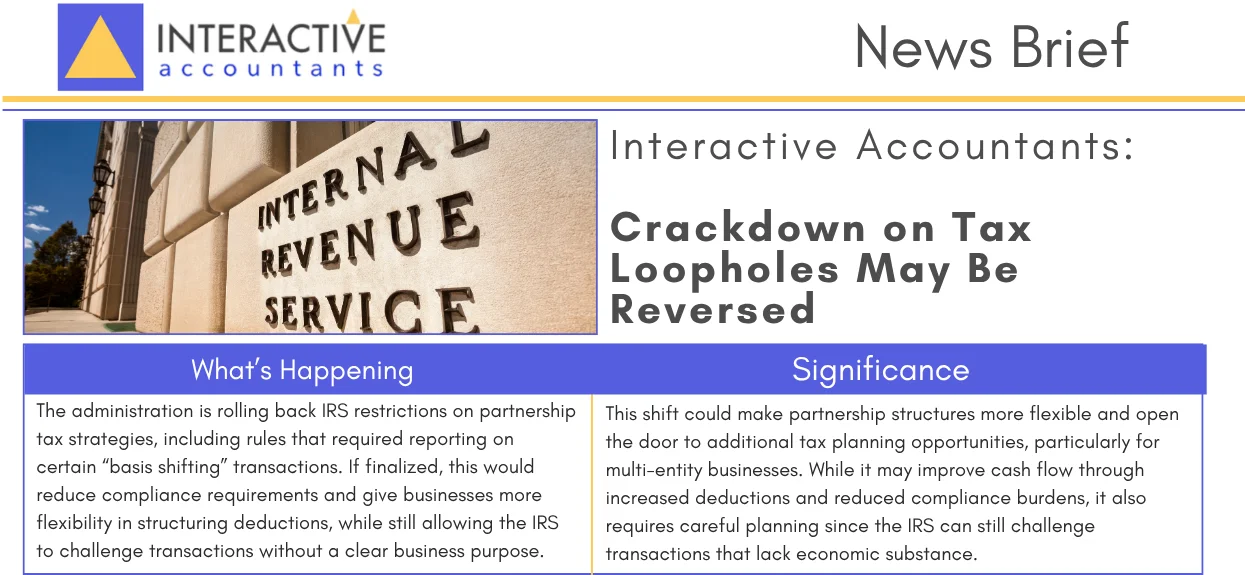
The administration is moving to roll back restrictions that targeted certain partnership tax strategies, particularly those involving “basis shifting.” These strategies generally involve transferring assets between related entities in a way that increases depreciation deductions and reduces taxable income.
Under prior rules, the IRS required enhanced reporting and placed greater scrutiny on these transactions to limit what it viewed as aggressive tax planning. The goal was to ensure that deductions reflected genuine economic activity rather than internal structuring designed primarily for tax benefits.
Now, those restrictions may be eliminated. Regulators have indicated that the rules were overly complex, difficult to enforce, and created unnecessary compliance burdens for businesses. If finalized, this rollback would remove reporting requirements and effectively reopen planning flexibility that many businesses had previously scaled back or avoided.
Why This Is Happening
This change reflects a broader shift toward a more business-friendly regulatory and tax environment. Policymakers are placing increased emphasis on reducing administrative burden and encouraging investment, particularly for businesses that rely on capital assets and layered entity structures.
At the same time, there has been ongoing criticism that prior rules were too broad, capturing legitimate transactions alongside more aggressive ones. As a result, the focus appears to be shifting away from strict reporting requirements and toward relying on existing enforcement doctrines rather than prescriptive rules.
What This Looks Like in Practice
To understand the concept, consider a simplified example.
A business owns equipment in one entity and transfers that asset to a related entity that generates taxable income. Under certain structures, this transfer can reset or accelerate depreciation schedules, creating additional deductions in the receiving entity.
These types of internal reorganizations, when done with a proper business purpose, have been used as part of broader tax planning strategies. The prior rules aimed to require disclosure and limit repeated use of these techniques across related entities.
With the rollback, some of those reporting requirements may no longer apply, potentially giving businesses more flexibility in how they structure internal transactions.
The Impact on Business Owners
This change is particularly relevant for businesses operating with multiple entities or partnership structures, including real estate investors, healthcare groups, logistics operators, and professional service firms.
For these businesses, the potential benefits may include:
- Increased flexibility in structuring asset ownership and transfers
- Opportunities to accelerate depreciation and improve near-term deductions
- Improved cash flow through more efficient tax positioning
- The ability to revisit strategies that were previously set aside due to compliance complexity
In practical terms, this could translate into meaningful tax savings depending on the size of the business and the nature of its assets.
What Business Owners Need to Know
Despite the rollback, this does not eliminate risk.
The IRS continues to rely on long-standing principles such as the economic substance doctrine. This means transactions must have a legitimate business purpose beyond tax reduction. Internal transfers that exist solely to generate deductions without real operational justification can still be challenged.
It is also important to note that regulatory changes are still evolving. Final guidance has not been fully established, and timing around implementation may affect planning decisions.
What You Can Do Now
This is a planning moment, not a reaction moment.
Business owners should begin by reviewing their current entity structure and identifying areas where asset placement, ownership, or intercompany transactions could be optimized. For some, this may involve revisiting strategies that were previously paused due to stricter compliance requirements.
Next, run forward-looking scenarios to understand how different structures could impact tax liability and cash flow in 2026 and beyond. The goal is to align tax strategy with actual business operations, not to separate the two.
Finally, work closely with your tax advisor before making any structural changes. Documentation, intent, and alignment with business activity will remain critical if strategies are ever examined.
Bottom Line
This policy shift signals a return to greater flexibility in partnership tax planning, but not a departure from scrutiny.
For business owners, the opportunity is real, but so is the responsibility to implement strategies thoughtfully. Those who act early, plan carefully, and tie tax decisions to legitimate business operations will be best positioned to benefit from this changing environment.